

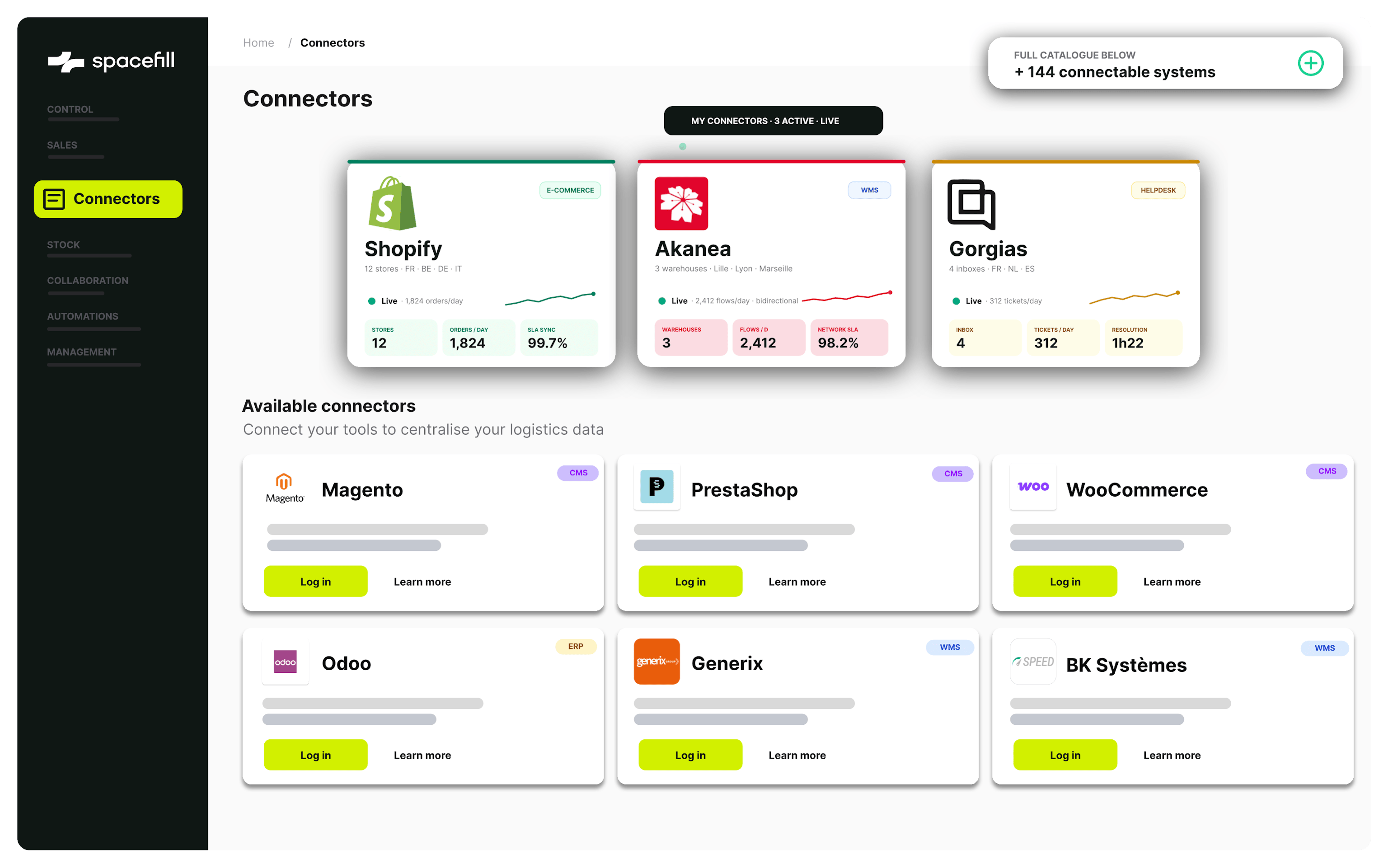
50+ WMS natively connected. Compatible with 100% of WMS on the market via API or EDI. Integration in under 30 days on average.

Discover the OMS
Orchestrate every order from capture to routing, across channels and sites.
Discover the IMS
Unify your inventory (warehouses, stores, transit, suppliers) into one real-time view.

Discover our Shipping Management
Track every parcel from picking to delivery, across all carriers.

3PL Management
Manage your logistics providers on the same data they see, in real time.

Discover our Workflows & Rules Engine
Automate your business rules with no IT ticket: trigger, condition, action.

Discover our AI agents
Four AI agents connected to your OMS: assistant, detection, data entry, routing.

Discover our Middleware
50+ native connectors and a REST API to plug in your entire ecosystem.
Stand out in RFPs
Walk into 3PL RFPs with a white-label customer portal.
Simpler, more reliable connectivity with my customers
Simpler, more reliable connectivity with my customers and brands.

Give my customers full transparency
Your customers act on orders, incidents and inventory on their own.
Boost productivity on administrative tasks
Double the volume your admin team handles.
Order Management System
The OMS that digitizes your supply chain end to end, from 100K to 10M orders a year.

IMS
Centralize, manage and automate your inventory operations
3PL Control Tower
Outsource logistics without losing control of execution at each 3PL.
WMS Middleware
Connect any WMS and push logistics data out to your entire IT landscape.
Deliver on the customer promise (ATP/ATS)
Show an exact date from the product page, and hold to it.
Manage the supply chain end to end
Aggregate your WMS, TMS, 3PLs and carriers in real time on a single platform.
Orchestrate multi-site flows and inventory
Orchestrate inventory and orders across multiple warehouses and stores.
Manage my logistics providers end to end
A control tower over your 3PLs and carriers, with no IT project.
Connect any WMS.
Manage, alert, redistribute
from one single interface.
50+ WMS natively integrated. Configurable alerts, automated rules, flow replay. Logistics data leaves your WMS and feeds your ERP, your CRM and your management tools.
The problem
The logistics data exists. It's just out of reach.
Your WMS knows what's happening in the warehouse. Your ops, support and finance teams see none of it in real time. And every new WMS to connect turns back into a project.
WMS data stays locked inside the WMS
A held order, stock down to zero, a flow anomaly: the information exists in the WMS. It doesn't reach your ERP, your support tool or your Slack until someone decides to go and find it.

Issues are spotted too late, or not at all
With no configurable alerts, blocked flows stay silent. The WMS doesn't call you, but the end customer calls support two days after the incident.

Every new WMS turns back into an IT project
Your 3PL changes WMS, you open a warehouse abroad, you switch providers: every time, it's an integration from scratch. 3 to 6 months, a team tied up, a budget nobody planned for.
Architecture
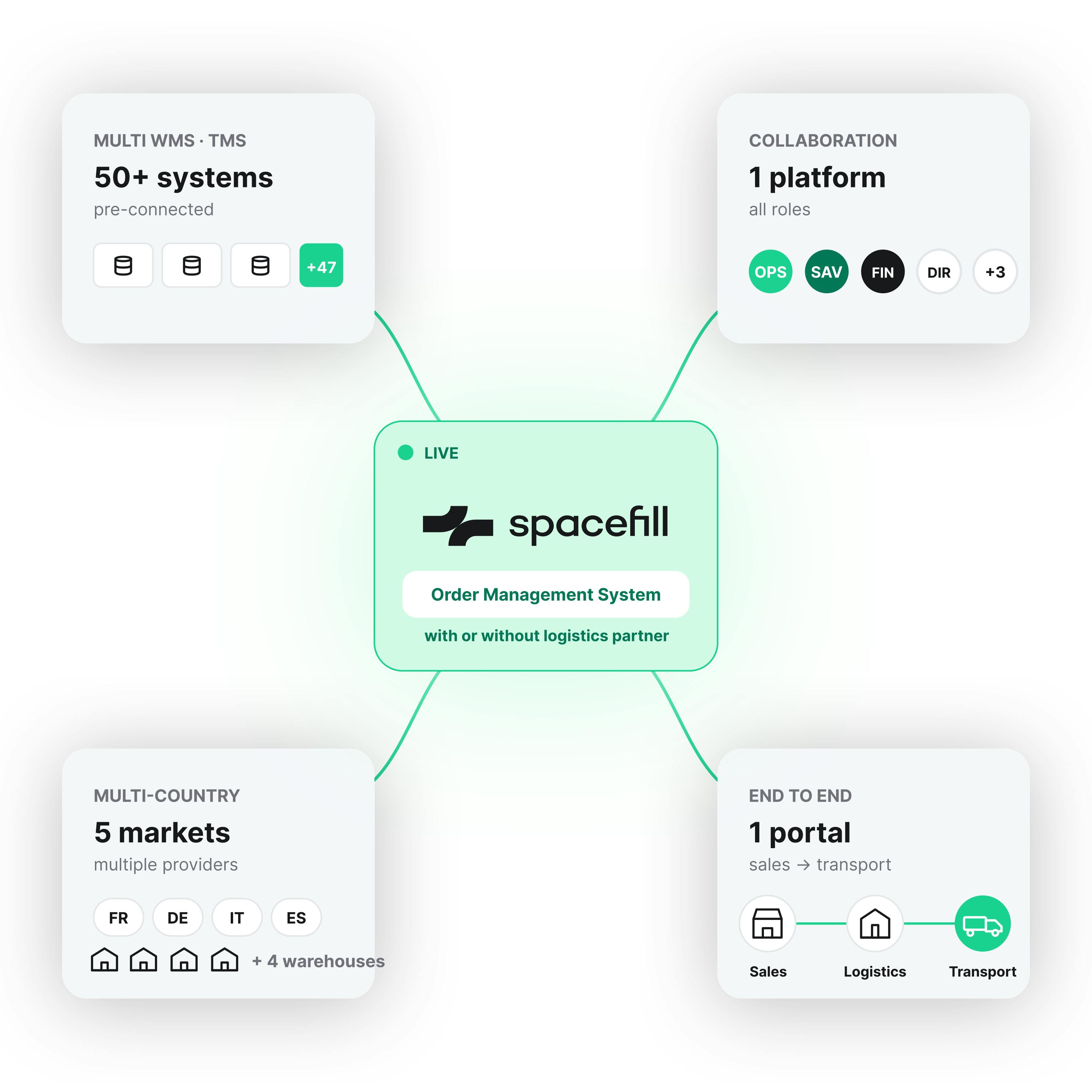
Spacefill as the orchestration layer between your systems and your WMS
Spacefill replaces nothing you already have. It sits in between, collects logistics data and redistributes it where it's useful, in both directions.
- On the execution side: 50+ pre-integrated WMS and TMS (Reflex, Effitrace, ODATIO, Speed, Infolog, StockIt…)
- At the centre: real-time alerts, automated rules, hold/replay, logs and monitoring, multi-destination redistribution
- On the business side: ERP (SAP, Sage, Oracle, Odoo, Axelor), CRM & support (Zendesk, Gorgias), accounting (Xero, Pennylane, Sellsy), messaging (Slack, Teams), BI (Power BI, Tableau, Metabase)
Two-way flow: WMS data feeds your systems, and your business systems can in turn drive the WMS through the rules you've configured.
Why Spacefill
Four reasons to go through Spacefill

Control from the very first WMS
You don't need 10 WMS for Spacefill to pay off. From the first connected WMS, you get alerts, rules, replay and monitoring.

Logistics data feeds your entire IT landscape
No more silos. Stock, orders, shipments, incidents: WMS data is distributed to your ERP, CRM, accounting, BI, Slack and Teams.

50+ WMS connected, no custom development
Reflex, Effitrace, ODATIO, Speed, Infolog, StockIt, Bext, Mecalux, EPG, Akanea, and 40+ others. No external maintenance contract, no dev team to mobilize.

Adding a warehouse is no longer an IT project
A new 3PL? A new international warehouse? The WMS connector already exists. Live in a few weeks, not a few months.
Practical cases
What it changes day to day
A flow gets stuck in the WMS. Nobody knows.
With Spacefill: an automatic Slack or Teams alert as soon as the flow stops. Replay can be triggered in one click. The incident never becomes a customer complaint.

You switch 3PL. New WMS.
With Spacefill: the connector already exists in the catalogue of 50+ WMS. Live in weeks, not months. No IT project to launch.
You open a warehouse in Germany.
With Spacefill: the German WMS plugs into the middleware. The data feeds your French ERP exactly as if it were the domestic WMS.

Your support team handles disputes with no view of the warehouse.
With Spacefill: order status, tracking and incidents published in real time in Zendesk or Gorgias. The agent has the full picture without switching tools.


Integrations
Your WMS is probably already in our network


Common objections
What people ask before deciding

"We already have an ESB or middleware in-house. Why add another one?"
A general-purpose ESB is flexible but requires developing each WMS connector and modelling the logistics objects. Spacefill covers supply chain natively: 50+ WMS, alerts pre-typed on logistics objects (order, stock, shipment), multi-destination redistribution. The ESB stays relevant for non-logistics flows.
"I only have one WMS. Is it worth it?"
Yes. The ROI doesn't depend on the number of WMS but on the quality of control: real-time alerts, automated rules, redistribution to ERP/CRM/Slack, flow replay, monitoring. All of it lands from the first connected WMS. With genuine reversibility on top: adding a second WMS later becomes trivial.
"Do we have to change WMS to use Spacefill?"
No. Spacefill connects to your existing WMS through a native connector (50+ WMS) or via API/EDI/CSV/FTP integration. The WMS keeps running normally, Spacefill captures the flows in parallel. Nothing changes for your operations teams or for your 3PL.
Connect any WMS. Manage everything from one interface.