

50+ WMS natively connected. Compatible with 100% of WMS on the market via API or EDI. Integration in under 30 days on average.

Discover the OMS
Orchestrate every order from capture to routing, across channels and sites.
Discover the IMS
Unify your inventory (warehouses, stores, transit, suppliers) into one real-time view.

Discover our Shipping Management
Track every parcel from picking to delivery, across all carriers.

3PL Management
Manage your logistics providers on the same data they see, in real time.

Discover our Workflows & Rules Engine
Automate your business rules with no IT ticket: trigger, condition, action.

Discover our AI agents
Four AI agents connected to your OMS: assistant, detection, data entry, routing.

Discover our Middleware
50+ native connectors and a REST API to plug in your entire ecosystem.
Stand out in RFPs
Walk into 3PL RFPs with a white-label customer portal.
Simpler, more reliable connectivity with my customers
Simpler, more reliable connectivity with my customers and brands.

Give my customers full transparency
Your customers act on orders, incidents and inventory on their own.
Boost productivity on administrative tasks
Double the volume your admin team handles.
Order Management System
The OMS that digitizes your supply chain end to end, from 100K to 10M orders a year.

IMS
Centralize, manage and automate your inventory operations
3PL Control Tower
Outsource logistics without losing control of execution at each 3PL.
WMS Middleware
Connect any WMS and push logistics data out to your entire IT landscape.
Deliver on the customer promise (ATP/ATS)
Show an exact date from the product page, and hold to it.
Manage the supply chain end to end
Aggregate your WMS, TMS, 3PLs and carriers in real time on a single platform.
Orchestrate multi-site flows and inventory
Orchestrate inventory and orders across multiple warehouses and stores.
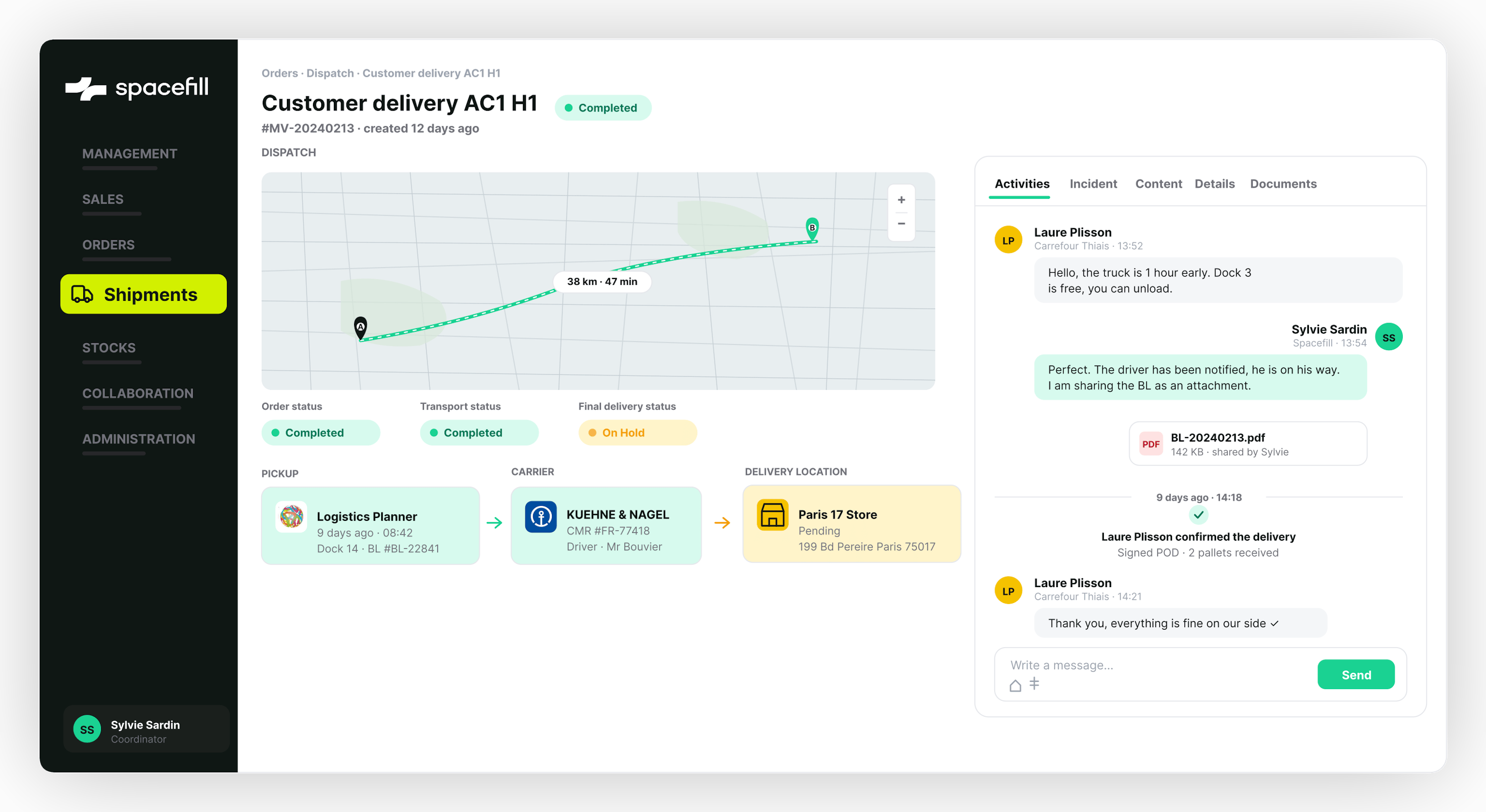
Manage my logistics providers end to end
A control tower over your 3PLs and carriers, with no IT project.
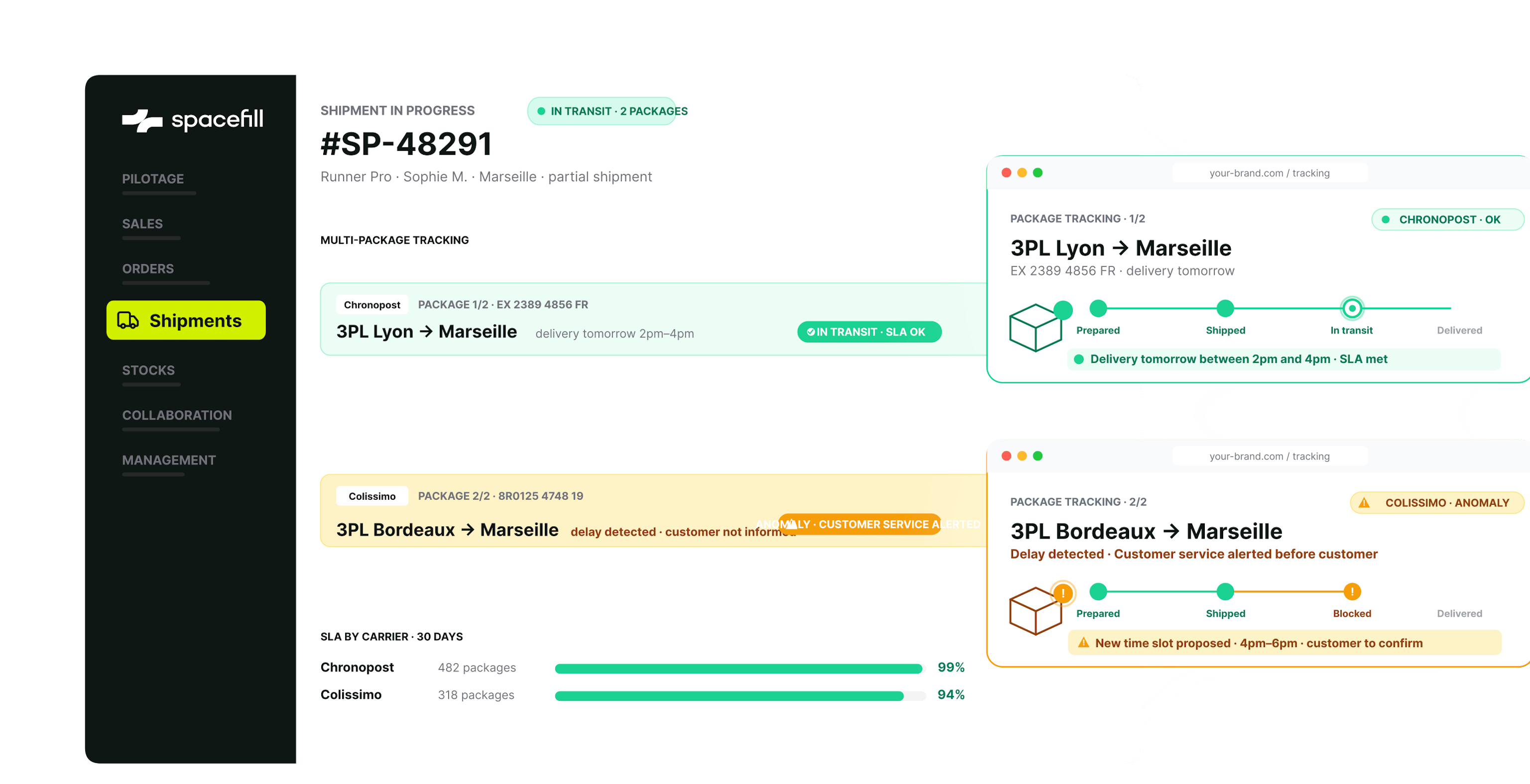
Every parcel tracked, from picking to delivery
Multi-carrier, multi-parcel, multi-site.
Spacefill consolidates tracking for every shipment in real time.
Catches issues before your customer does and measures contractual SLAs for every provider.

-%
01234567890123456789
01234567890123456789
WISMO calls, thanks to real-time visibility
-%
01234567890123456789
01234567890123456789
logistics-related support tickets
01234567890123456789
01234567890123456789
01234567890123456789
of contractual SLAs measured automatically
+%
01234567890123456789
01234567890123456789
checkout conversion with dynamic delivery promise
01234567890123456789
01234567890123456789
picking errors eliminated
The problem
Between picking and delivery, nobody sees the same thing
The WMS has its statuses. The carrier has its own. Support has neither. The customer calls. Without a single view of what happens between order confirmation and the customer's door, the whole experience suffers.

Support finds out about issues when the customer calls
The parcel has been stuck in a hub for 48 hours. The carrier failed the delivery. Picking ran late. Nobody on the brand side knows before the complaint comes in. By then it's too late to act: the customer has already lived the experience.

Every carrier has its own tracking system, incompatible with the others
Colissimo, DPD, Chronopost, a local courier for B2B: each carrier returns events in a different format, at a different frequency. When an order is split across two carriers, the consolidated view exists nowhere.

Provider SLAs go unmeasured
The 3PL reports 98% OTD. So does the carrier. But each number is calculated on their own side, with their own definitions. Without independent measurement, performance reviews rest on claims.
Returns are an operational blind spot
The customer sent the product back. The label was generated by a provider. The return parcel is in transit. The WMS has no expected receipt. The team discovers the return when the parcel lands at the warehouse, with no context and no link to the original order.
What changes
Five situations. One tool.
Situations logistics and support teams face every day.

Fragmented parcel tracking
Support logs into the carrier's website to check each parcel one by one. When an order has two parcels with two different carriers, that's two logins.

Single multi-parcel view
Every parcel in an order is tracked in one view, whatever the number of carriers. Support sees the status directly in the CRM.
Issues found too late
A carrier issue is discovered through a customer complaint, 48 hours after the failed delivery.
Proactive detection
The alert fires as soon as the issue is detected: before the customer needs to call, while there's still time to react.
Disputable SLAs
The 3PL's SLAs are assessed on the basis of its own reports. Gaps between "shipped" and "delivered" can't be traced.
Shared, factual SLAs
SLAs are measured automatically from the same data for both the brand and the provider. Performance reviews rest on facts.
How it works
From pick order to proof of delivery, everything is tracked
Four steps. Every logistics event consolidated. Every anomaly surfaced before the customer.

Pick order generation
Spacefill generates and sends pick orders to each relevant WMS or 3PL. Sales units are translated into logistics units. Two-way tracking starts from that moment.

Real-time pick, pack, ship tracking
Every event flows from the WMS back to Spacefill: picking, packing, carrier handover. If there's a shortage or an anomaly, actions fire according to your configured rules.

Consolidated multi-carrier tracking
Tracking numbers for every parcel are aggregated into a single view per order. Delivery events are pushed to your support desk (Zendesk, Gorgias), BI, Slack or Teams in real time.

Traced returns and measured SLAs
Every return is linked to its original order, with the label generated and the expected receipt sent to the WMS. Picking and delivery SLAs are measured automatically, provider by provider.

Integrations
Your WMS is probably already in our network


Common objections
What people ask before deciding

"We already have a TMS. Why add Spacefill?"
A TMS handles transport routing and carrier billing. Spacefill doesn't replace it: it consolidates tracking events from all your carriers (both inside and outside the TMS), pushes them into your support and BI tools, and correlates them with your logistics data (picking, WMS orders) for an end-to-end view. The two work side by side.
"Our support team already uses Zendesk, we don't want to switch tools."
That's exactly the point. Spacefill plugs into Zendesk (and Gorgias) to push shipping statuses straight into the ticket view. Your agent sees the full tracking without leaving their tool. It's a native connector, not an integration project.
"Returns are handled by our 3PL, we don't need another layer."
The 3PL handles the physical receipt of the return, but the link between the return parcel and the original order is often broken. Spacefill maintains that traceability end to end: label generation, expected receipt in the WMS, handling of gaps between declared and received, automatic refund trigger.
Every parcel tracked, every issue caught early.
Shipping management questions
Shipping management is the OMS layer that orchestrates and tracks the shipment of an order, from pick order generation through to proof of delivery. It consolidates logistics events (pick, pack, ship) and transport events (transit, delivery) into a single view, across multiple carriers and multiple parcels. Spacefill also covers returns and SLA measurement.
No. A TMS handles transport routing (carrier selection by weight and zone), label generation and carrier billing. Spacefill connects to your TMS and to carriers directly, consolidating tracking events and redistributing them to your other tools (support CRM, BI). The two work side by side.
Each parcel has its own tracking number and its own carrier. Spacefill aggregates events from every parcel into a single view at order level. Support sees the status of each parcel at a glance, whatever the carrier. The "order delivered" logic accounts for all parcels.
Spacefill connects natively to Zendesk and Gorgias. When a shipping or delivery event comes in, the status is pushed to the matching ticket. Your support agent sees the full tracking for every parcel directly in their tool, without opening another interface.
Yes. Automatic label generation through carriers (Teliae, TDI, ITinsell, Sendcloud), return tracking from collection through to WMS receipt, expected receipt sent to the 3PL, handling of undeclared returns and gaps between declared and received quantities. Every return is linked to its original order.
Spacefill captures every event (pick, pack, ship, delivery) and continuously calculates compliance with contractual lead times. SLAs are measured automatically by 3PL, by carrier, by customer and by channel. The figures are available to both the brand and the provider: the data is shared.
25+ native connectors on the transport side: Colissimo, Chronopost, DPD, DHL, GLS, UPS, FedEx, Mondial Relay, plus the GedMouv, Akanea, Sendcloud, ITinsell, Teliae and TDI TMS platforms. For local or uncovered carriers, Spacefill teams build the integration via API or EDI.
Yes. Spacefill exposes a delivery promise API that calculates the available delivery date in real time based on stock, shipping site, carrier cut-offs and customer zone. It integrates natively with Shopify, PrestaShop, WooCommerce and Magento, or via API with any other platform.