

50+ WMS natively connected. Compatible with 100% of WMS on the market via API or EDI. Integration in under 30 days on average.

Discover the OMS
Orchestrate every order from capture to routing, across channels and sites.
Discover the IMS
Unify your inventory (warehouses, stores, transit, suppliers) into one real-time view.

Discover our Shipping Management
Track every parcel from picking to delivery, across all carriers.

3PL Management
Manage your logistics providers on the same data they see, in real time.

Discover our Workflows & Rules Engine
Automate your business rules with no IT ticket: trigger, condition, action.

Discover our AI agents
Four AI agents connected to your OMS: assistant, detection, data entry, routing.

Discover our Middleware
50+ native connectors and a REST API to plug in your entire ecosystem.
Order Management System
The OMS that digitizes your supply chain end to end, from 100K to 10M orders a year.

IMS
Centralize, manage and automate your inventory operations
3PL Control Tower
Outsource logistics without losing control of execution at each 3PL.
WMS Middleware
Connect any WMS and push logistics data out to your entire IT landscape.
Deliver on the customer promise (ATP/ATS)
Show an exact date from the product page, and hold to it.
Manage the supply chain end to end
Aggregate your WMS, TMS, 3PLs and carriers in real time on a single platform.
Orchestrate multi-site flows and inventory
Orchestrate inventory and orders across multiple warehouses and stores.
Manage my logistics providers end to end
A control tower over your 3PLs and carriers, with no IT project.
Simpler, more reliable connectivity with my customers
Simpler, more reliable connectivity with my customers and brands.

Give my customers full transparency
Your customers act on orders, incidents and inventory on their own.
Boost productivity on administrative tasks
Double the volume your admin team handles.
Stand out in RFPs
Walk into 3PL RFPs with a white-label customer portal.
Your stock. All your sites.
In real time.
Warehouses, stores, suppliers, in transit: Spacefill consolidates every stock position
from all your sites and systems into a single view, continuously synced.
No stockouts, no overselling.
The real cost of fragmented inventory
When your stock is scattered, every order is a gamble.
As soon as you sell on more than one channel, run more than one store or warehouse, or work with logistics partners, your inventory visibility fragments. The data lives in different systems. Nobody sees the same number.

Overselling and stockouts
Each channel draws from its own siloed stock pool. A product shows as available on your e-commerce site while the last unit is already being picked for a marketplace order.
Stock split by constraint, not by choice
Your ERP has its version of stock. Your e-commerce platform has another. Each 3PL runs its own WMS. Reconciling them is manual work that costs hours every week and still doesn't produce a reliable number.
No consolidated view of available-to-sell
Your customer service and supply teams make sub-optimal routing decisions, while your merchandising team replenishes the wrong warehouses.
In-transit and supplier stock is invisible
Stock moving between sites, in transit, in receiving, or sitting at a supplier on a confirmed order or quote: none of it shows up in real time. You can't promise delivery on stock arriving within 48 hours, or make the right allocation decisions.
What Spacefill changes
One unified, real-time inventory view. Every site. Every system.
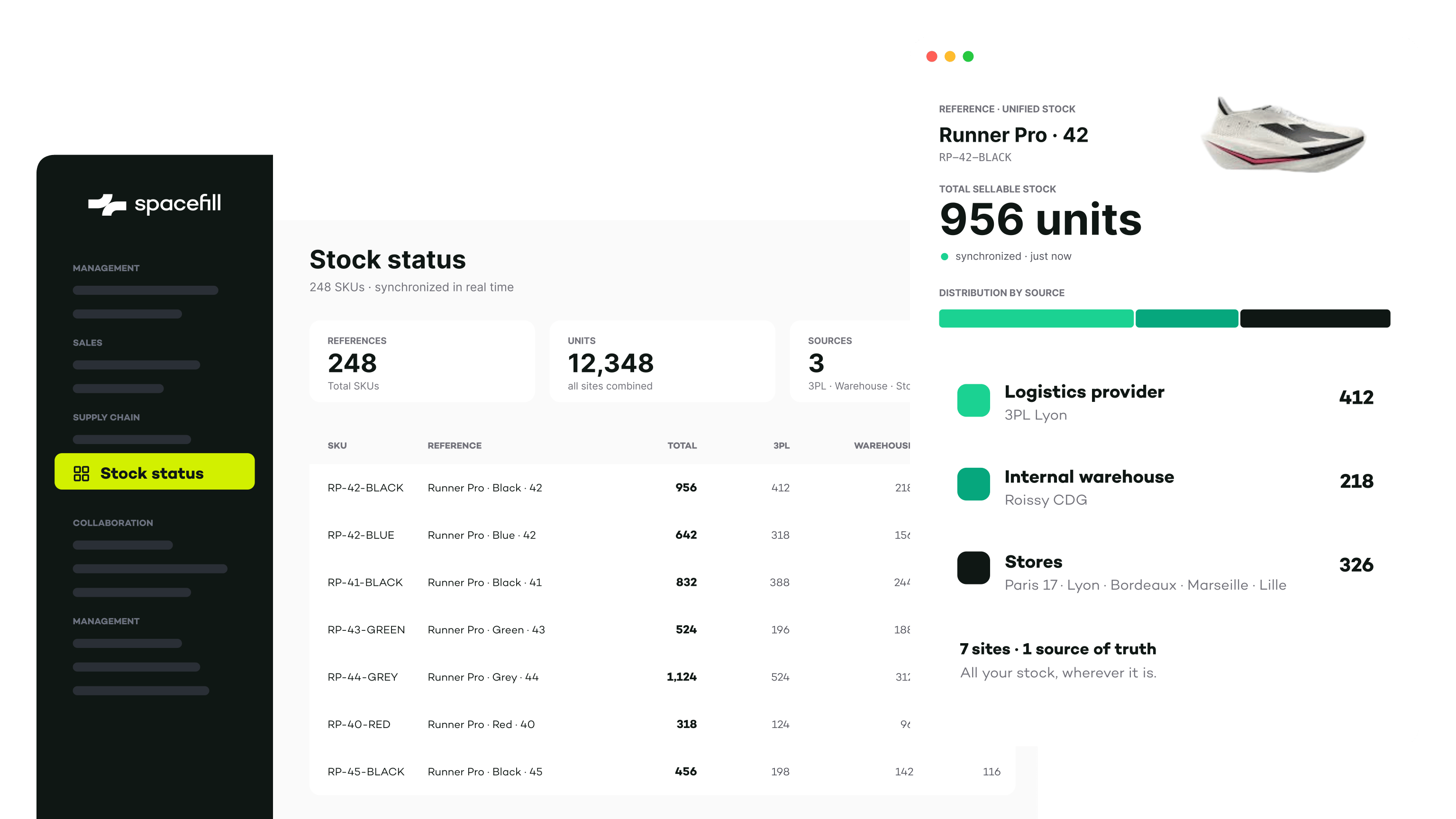
Aggregate inventory from all your WMS, ERP, stores, transport and suppliers into a single continuously synced layer. This is the stock truth your orchestration engine, your delivery promise and your replenishment can finally rely on.

Unified stock across every node
Warehouses, stores, suppliers, consignment stock, in-transit stock, all visible in one place, down to SKU and location level.

Real-time sync, not an overnight batch
Stock positions update in near real time from every connected WMS, ERP and POS. No more decisions made on yesterday's data.

Accurate available-to-promise
Spacefill calculates real ATP per site, factoring in reservations, inbound deliveries and replenishments, and incoming supplier orders. Promise what you can actually deliver.

Automatic alerts, no manual monitoring
Low stock thresholds, imminent stockouts, abnormal turnover rates: detect and notify without watching your dashboards all day.
How it works
Five capabilities that change what you can do.
Unified inventory layer
All your stock positions, in one place.
Spacefill connects to your ERP, your store POS systems and your 3PLs' WMS. It aggregates every position (physical stock, reserved units, in transit, supplier POs) into a single normalized view.
50+ WMS natively connected.
Real-time synchronization
No more decisions based on yesterday's numbers.
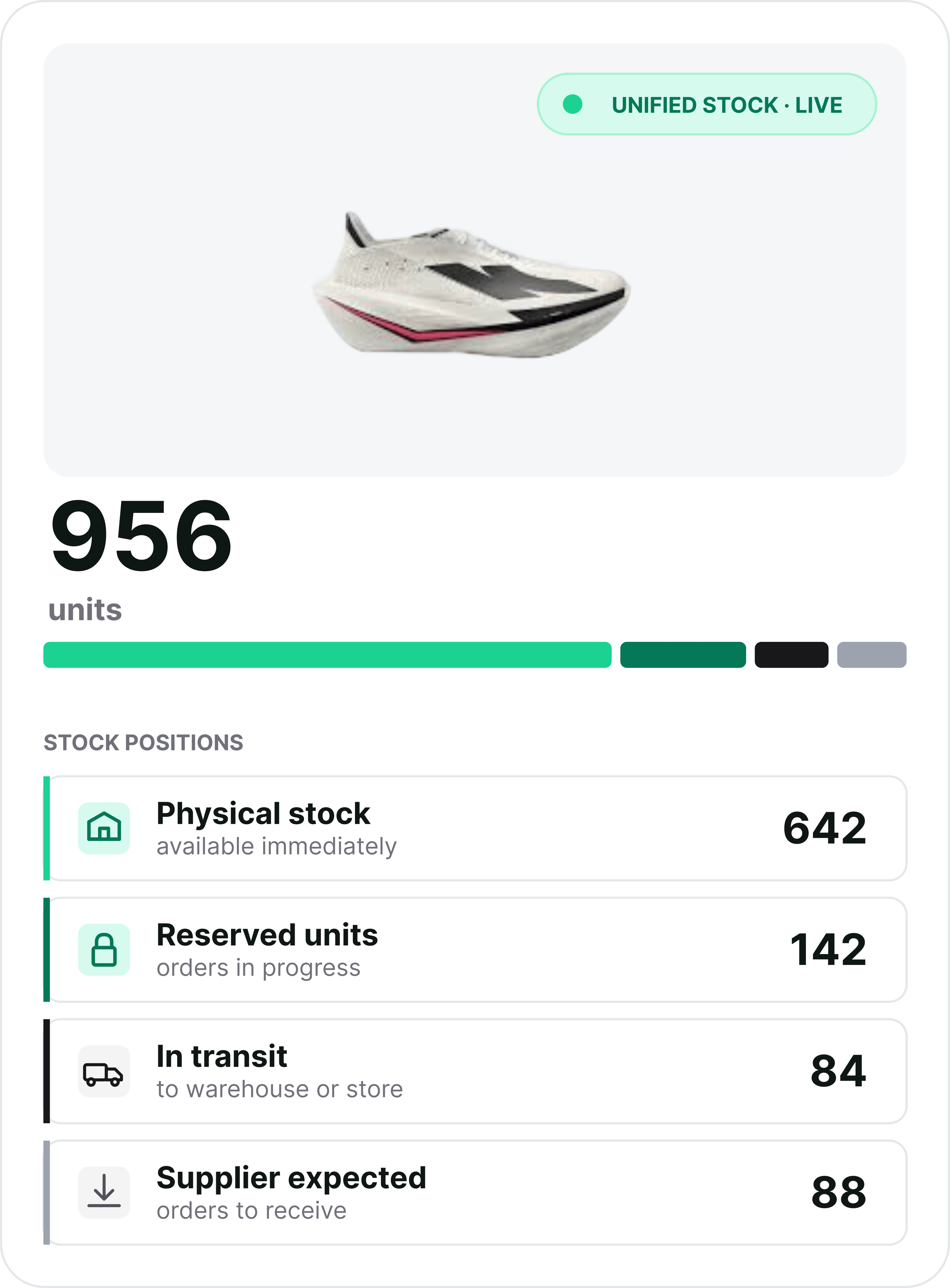
Sync latency under 30 seconds for webhook-compatible WMS. Automatic conflict resolution when two sources report different quantities. Full traceability.
−94% picking errors and stock discrepancies observed across Spacefill customers.
Promesse de livraison
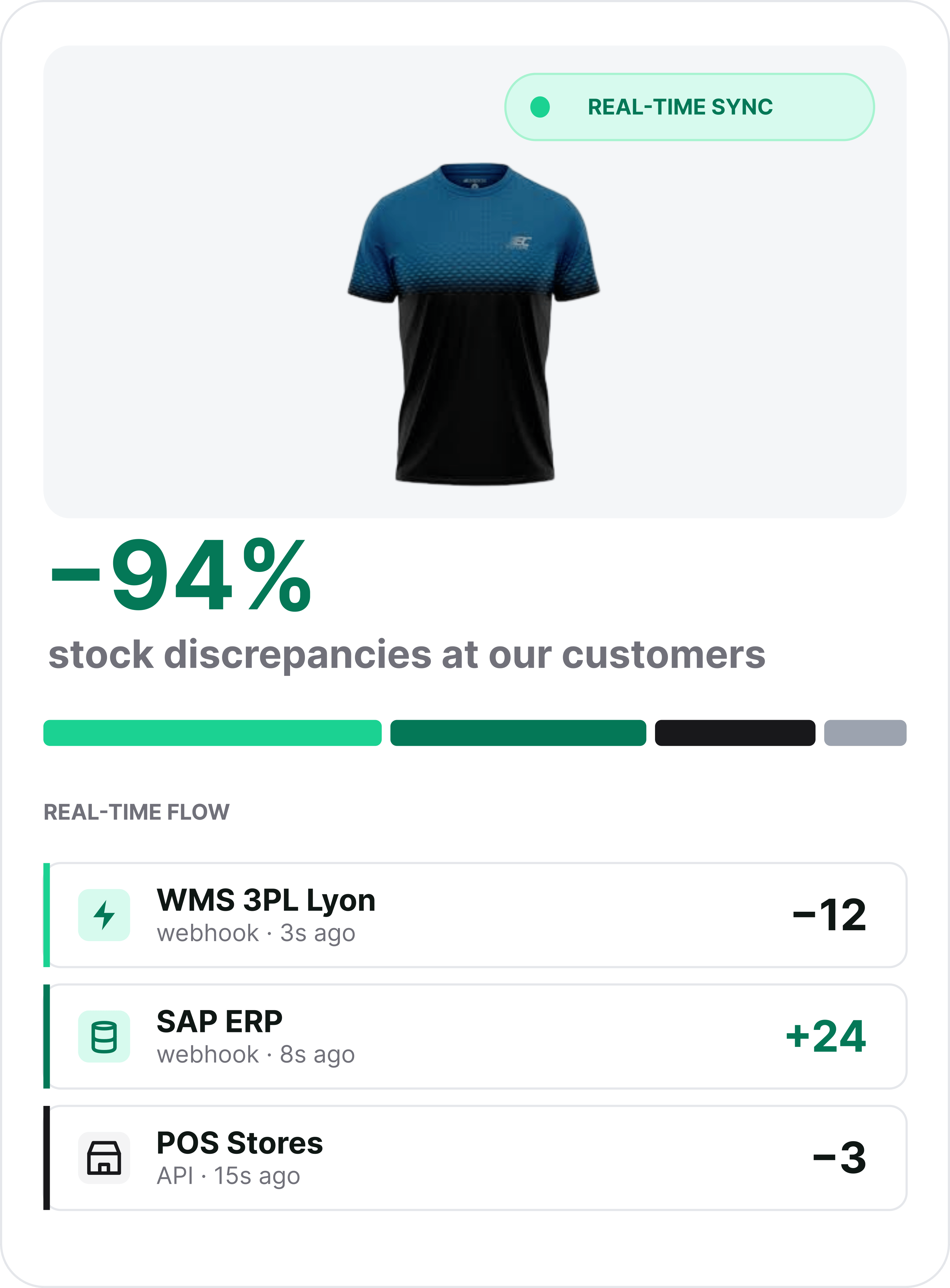
Tell your customer exactly when they'll receive their order.
At checkout, calculate in real time which node can ship, at what cost, and by when. Show a precise date, not "3 to 5 business days".
+12% conversion on average.
Inventory rules and allocation
Allocate stock the way your business actually needs.
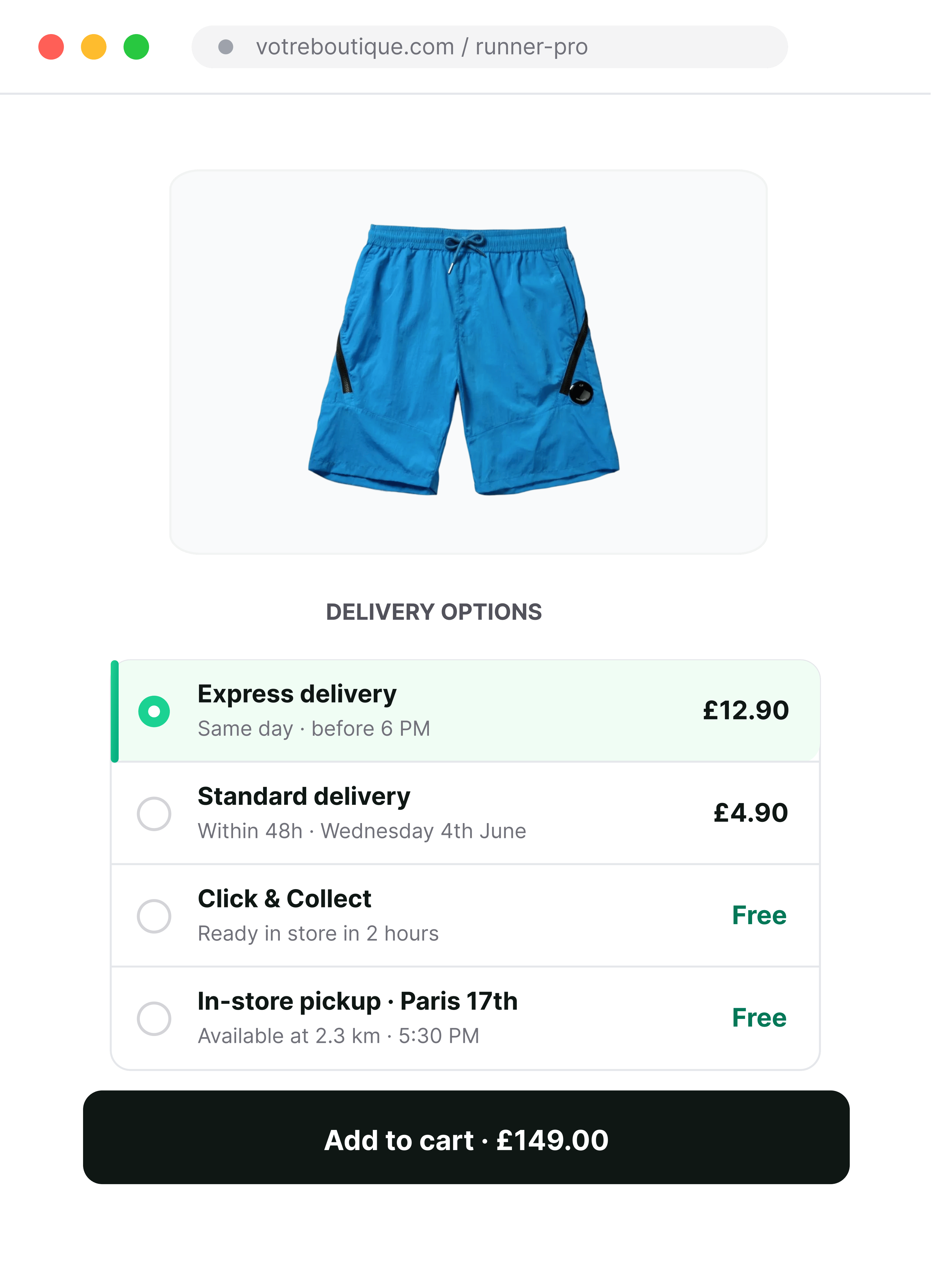
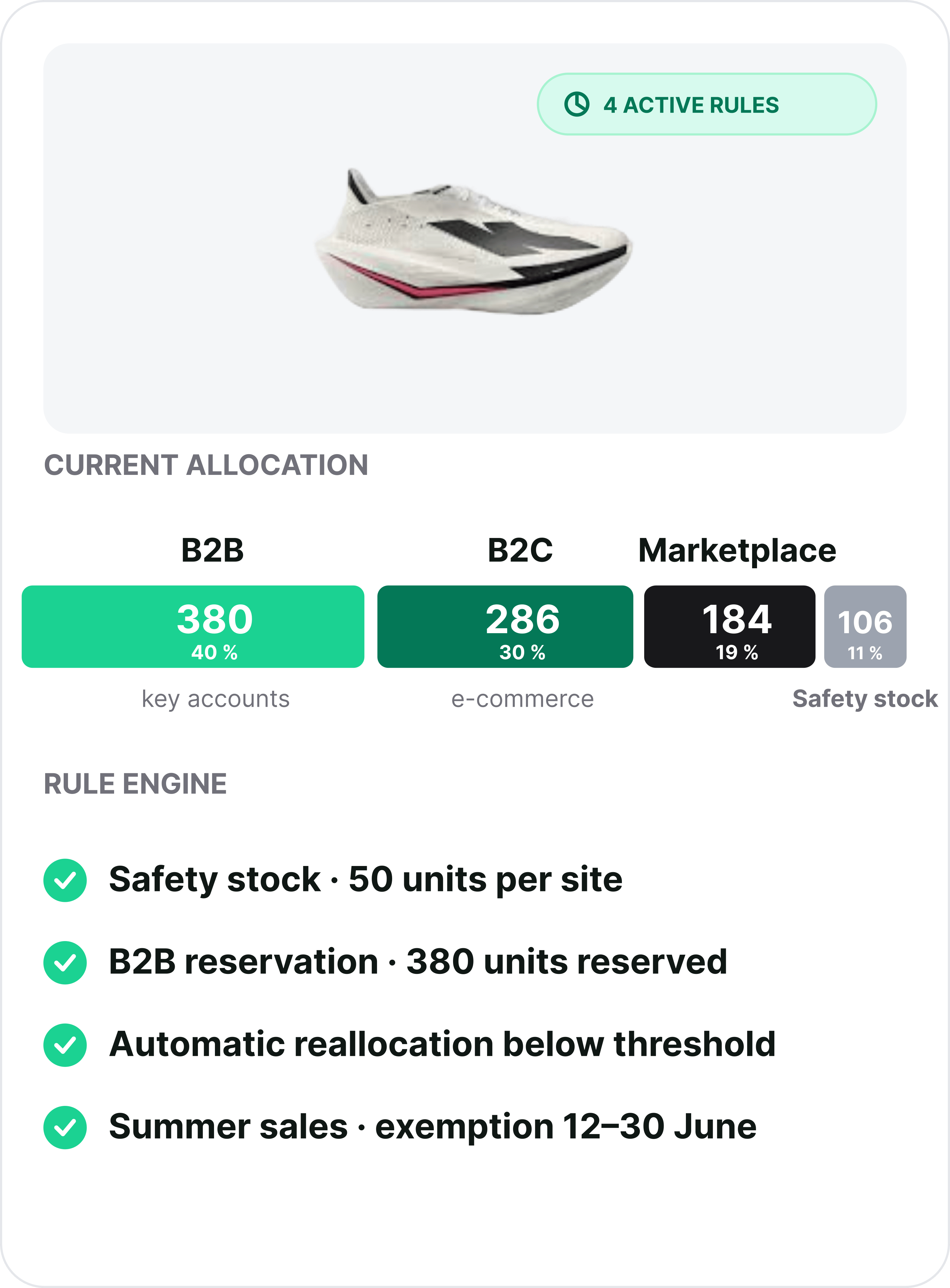
Ring-fence inventory for your B2B customers, protect safety stock, prioritize specific channels. Configure allocation logic without touching the WMS.
+18% inventory turnover.
Middleware and normalization
Connect every source. Spacefill normalizes the data.
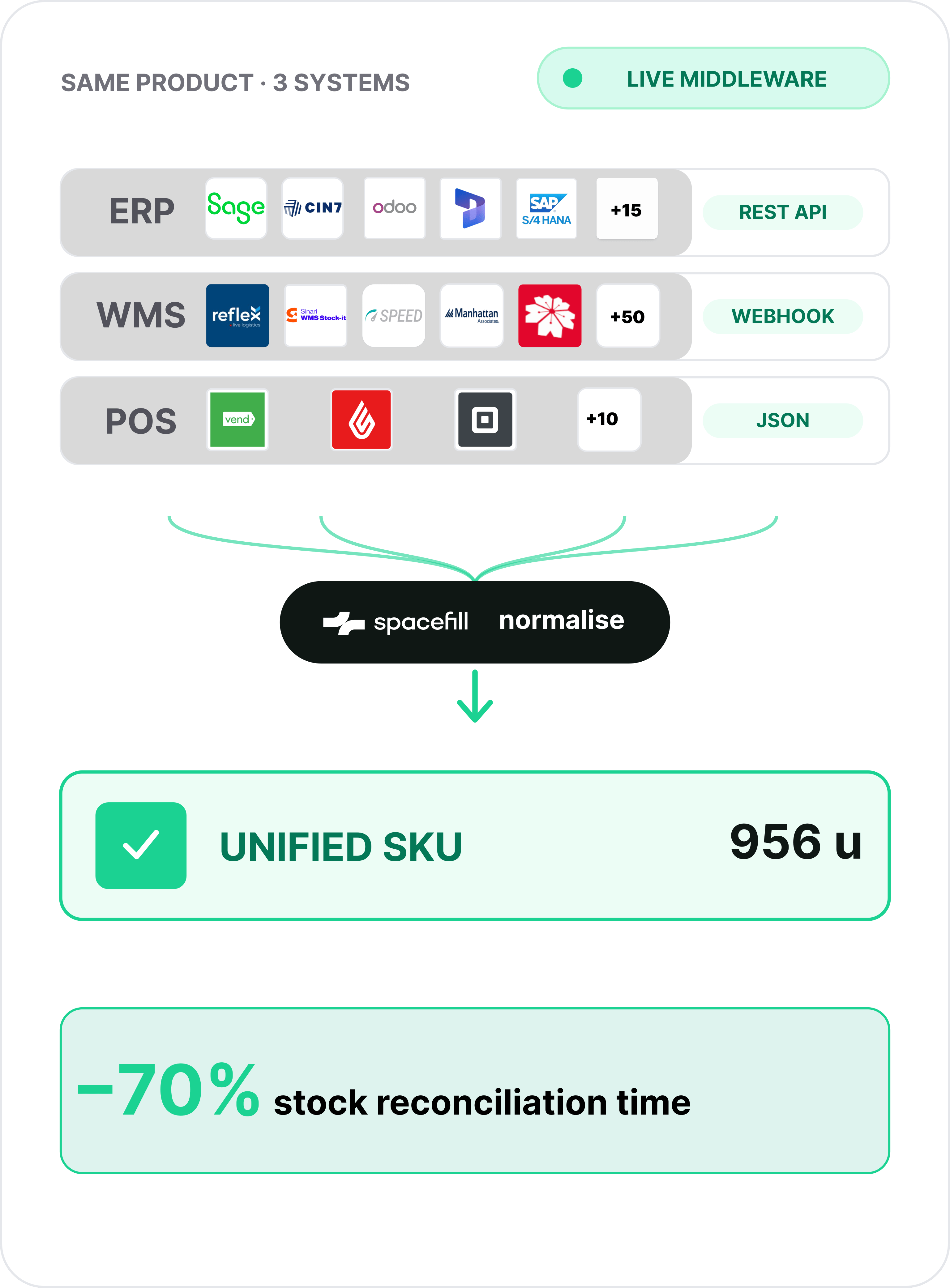
Pre-built connectors: REST API, webhooks, EDI, SFTP. Automatic product master data mapping. Discrepancy reconciliation.
−70% time spent reconciling stock.
Smart alerts
Your inventory is telling you something. You just have to hear it
Imminent stockout
ATP stock drops below the defined minimum threshold. An alert fires automatically before the stockout actually happens, identifying the most exposed channel.
Action: draft replenishment PO + Slack notification

Abnormally low turnover
A SKU sits still at one site while it sells well elsewhere. Spacefill detects the gap and flags a potential localized overstock or a channel availability issue.
Action: variance report + inter-site transfer suggestion

Stock imbalance across sites
One warehouse is saturated while another is close to a stockout on the same SKU. Alert with a rebalancing recommendation and an estimated transfer cost.
Action: inter-site rebalancing recommendation

Supplier receipt confirmed
A supplier PO moves to "confirmed" status. Spacefill factors the expected stock into future ATP and notifies sales teams, who can start committing to customers right away.
Action: future ATP update + sales team notification

What changes when your inventory becomes reliable and visible
-%
01234567890123456789
01234567890123456789
picking errors and stock discrepancies
+%
01234567890123456789
01234567890123456789
checkout conversion with real-time delivery promise
-%
01234567890123456789
01234567890123456789
time spent reconciling stock across systems
+%
01234567890123456789
01234567890123456789
inventory turnover with dynamic allocation
Before / After
What actually changes when inventory goes real time.
Siloed stock data
Stock data lives in 4 different systems. Reconciliation is a weekly manual job.

Unified inventory layer
One single unified inventory layer. Updated in near real time from every source.
E-commerce overselling
Your storefront shows "in stock" on items that are reserved or already out at the 3PL.
Reliable ATP, no more overselling
ATP is calculated from real stock minus reservations. Overselling stops.
Vague delivery promise
The checkout promise is generic ("3 to 5 business days") and conversion suffers.
Precise date at checkout
Checkout shows the exact delivery date. Conversion rises by an average of 12%.

Integrations
Your WMS is probably already in our network



You won't trust your inventory data until you see all of it in one place.
Frequently Asked Questions about our IMS
Everything you need to know before getting started
An IMS is inventory management software that enables real-time tracking of inventory levels, automates replenishment alerts, and optimizes inventory turnover. It connects to Warehouse Management Systems (WMS) and e-commerce platforms to provide a unified view of all your inventory.
A WMS (Warehouse Management System) manages physical operations inside a warehouse (receiving, storage, picking, packing).
An IMS operates at a more strategic level, overseeing inventory across multiple warehouses and logistics providers.
Spacefill acts as a middleware, connecting your ERP to your 3PLs’ WMS to deliver a consolidated inventory view.
Spacefill offers pre-built connectors with leading WMS solutions on the market (Akanea, Stock-iT, Infolog, etc.).
Implementation is fast (a few weeks) and requires no heavy development on your side.
For WMS not yet connected, we build custom integrations.
Spacefill is designed for brands and retailers with annual revenue between €5M and €100M that outsource their logistics.
If you work with one or more 3PLs and need better inventory visibility, Spacefill is built for you.
Deployment typically takes 2 to 4 weeks, depending on the complexity of your logistics ecosystem and the number of 3PLs to connect.
We provide dedicated support throughout the entire process.
No. Spacefill integrates with your existing ERP.
It acts as a connectivity and visibility layer between your information system and your logistics partners’ WMS.
Spacefill connects to major European marketplaces, including Amazon, Cdiscount, Fnac, eBay, ManoMano, La Redoute, and more.
Your inventory is synchronized in real time across all sales channels.