









Your customer promise, delivered.
On every order.
Show a precise delivery date from the product page onwards. Hold it through to final delivery, even when your fulfilment spans several warehouses, several 3PLs and several sales channels.
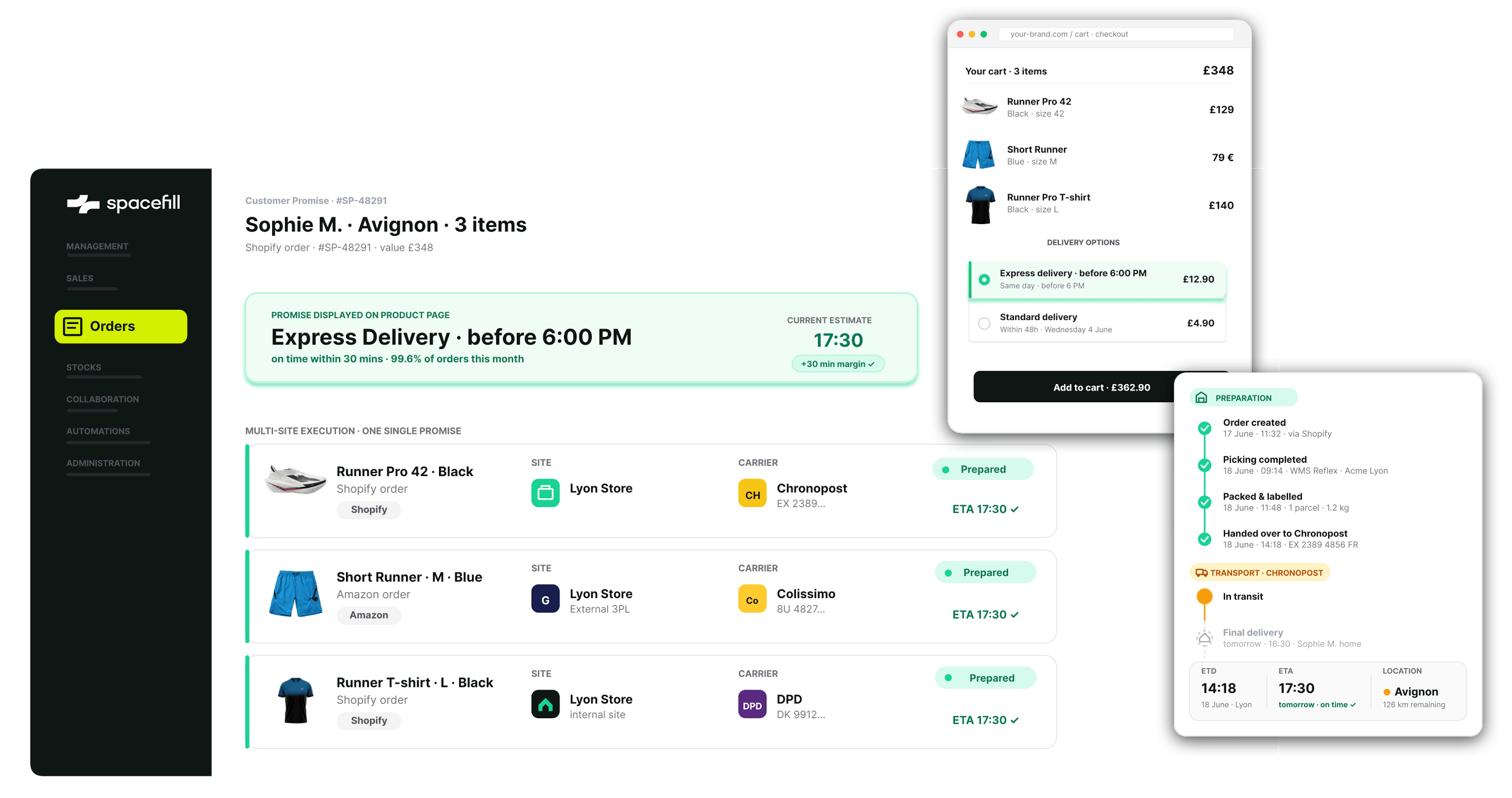
The promise decides the sale. And everything after.
At checkout, a visitor looks at two things: the price and the delivery date. If the date is vague, they leave. If the date is precise and then missed, they don't come back.

A precise date converts better than a range
"Delivery in 3 to 7 days" loses to "Thursday 16 April before 1pm". Precision removes hesitation at the moment it costs the most: right before payment. In competitive markets, a vague promise sends the customer straight to the next tab.

Historical lead times aren't enough anymore
An accurate promise isn't calculated from a six-month average. It's calculated from the real stock at each site, each carrier's collection cut-offs, and each warehouse's picking capacity. In real time. On every order.

A missed promise costs more than a modest one kept
WISMO requests, an overloaded support team, negative reviews, falling repeat purchase rates, acquisition spend burned. The cost of a broken promise is consistently underestimated. A modest promise kept earns more than an ambitious one that fails one time in ten.

logistics-related support tickets
checkout conversion
picking errors eliminated
of contractual SLAs measured in real time
Spacefill OMS features
Every module you need to display a precise promise and keep it, from the product page to final delivery.

Unified stock, in real time, down to the position
Instant aggregation of stock across WMS, 3PLs, stores and suppliers, via API, EDI, CSV or FTP. Every unit is qualified: available, reserved, held, damaged, in transit. Available-to-sell stock recalculates continuously, accounting for orders already being picked.

An ATP/ATS calculation that combines physical and logical
Sellable availability factors in the physical stock on site, reserved quantities, supplier POs in transit and future allocations. Your storefronts show availability that matches operational reality, not yesterday's export.

Availability exposed to all your channels
A consolidated multi-site availability API. One call from your website, your checkout, your marketplaces or your back office. Responses are contextualized by channel, by country and by delivery method.
Quotas and reserves by sales channel
Protect your strategic stock. Reserve a volume for the physical store, another for e-commerce, another for a marketplace or a key B2B account. Rules are configured in the interface, with no development.

Pre-orders without distorting physical stock
Take orders on a product that isn't available yet without polluting sellable stock on your other channels. The firm order, the logical reservation and actual availability are handled separately.
In-store e-reservation
The customer reserves online, then comes in to try or collect. Stock is held without payment for the chosen window, then released automatically if nobody shows up. Store traffic rises, stock keeps moving.
Delivery promise calculated at checkout
A precise date shown to the customer at the moment of payment, factoring in carrier cut-offs, picking time per site, transit times and multi-parcel splits. The promise becomes the constraint orchestration has to respect, not a decorative display.

Carbon footprint built into the promise
Every delivery option carries a carbon estimate. The customer can weigh speed, cost and impact. The brand can show the lowest-impact option by default and turn a sustainability topic into a conversion lever.

Orchestration driven by the commitment made
Once the promise is displayed, the order routing engine picks the site or combination of sites that can meet it. Combined criteria: availability, proximity, lead time, cost, capacity, contractual priority. Decision made in near real time.

A rules engine operated by your business teams
Trigger, condition, action. Create or change a rule in under 10 minutes, with no IT ticket.

Proactive detection by AI agents
3PL delays, picking saturation, SLA breaches. The anomaly is identified before the customer notices. The alert goes to Slack, Teams, Zendesk or Gorgias. Detection speed is three times faster than human monitoring.
Unified post-purchase tracking
One order, several parcels, several carriers. Your support agents see everything from their usual tool, without calling the warehouse or the carrier. The customer gets clear information at every step, and proactive communication when something goes wrong.
What sets Spacefill apart
Four product choices no other OMS brings together in one place.
Built for complex fulfilment
Multi-warehouse, multi-3PL up to 100+ sites, multi-country, multi-channel. Where other OMS platforms stop at stores plus an internal distribution centre, Spacefill also orchestrates outsourced logistics. A shipper working with a single provider gets the same interface as one running fifty.

50+ WMS and TMS natively connected
Akanea, Reflex, Infolog, Speed, Bext, Mecalux, EPG, Sinari, Effitrace, Odatio and more. Your 3PLs keep their own systems, the data flows straight into Spacefill. Deployment is measured in weeks, not in a six-month IT project.
The promise defended by a rules engine, not by someone on duty
The conditions that threaten the promise (shortage, site delay, carrier saturation) trigger automatic actions: reallocation, hold, notification, escalation. 90% of manual work on exceptions disappears. Ops teams focus on the genuinely critical cases.

AI agents between detection and action
Anomaly detection before impact, plain-language answers for ops and support teams. 50% less time to handle a support ticket, 40% less time spent by ops teams.
Ready to make promises you'll actually keep?