

Grow your sales and deliver on your customer promise in real time with our omnichannel OMS.

Discover the OMS
Orchestrate every order from capture to routing, across channels and sites.
Discover the IMS
Unify your inventory (warehouses, stores, transit, suppliers) into one real-time view.

Discover our Shipping Management
Track every parcel from picking to delivery, across all carriers.

3PL Management
Manage your logistics providers on the same data they see, in real time.

Discover our Workflows & Rules Engine
Automate your business rules with no IT ticket: trigger, condition, action.

Discover our AI agents
Four AI agents connected to your OMS: assistant, detection, data entry, routing.

Discover our Middleware
50+ native connectors and a REST API to plug in your entire ecosystem.
Stand out in RFPs
Walk into 3PL RFPs with a white-label customer portal.
Simpler, more reliable connectivity with my customers
Simpler, more reliable connectivity with my customers and brands.

Give my customers full transparency
Your customers act on orders, incidents and inventory on their own.
Boost productivity on administrative tasks
Double the volume your admin team handles.
Order Management System
The OMS that digitizes your supply chain end to end, from 100K to 10M orders a year.

IMS
Centralize, manage and automate your inventory operations
3PL Control Tower
Outsource logistics without losing control of execution at each 3PL.
WMS Middleware
Connect any WMS and push logistics data out to your entire IT landscape.
Deliver on the customer promise (ATP/ATS)
Show an exact date from the product page, and hold to it.
Manage the supply chain end to end
Aggregate your WMS, TMS, 3PLs and carriers in real time on a single platform.
Orchestrate multi-site flows and inventory
Orchestrate inventory and orders across multiple warehouses and stores.
Manage my logistics providers end to end
A control tower over your 3PLs and carriers, with no IT project.
The order management system that digitizes your supply chain end to end
Optimize your delivery promise. Unify your inventory. Orchestrate your orders.
Manage your logistics providers and carriers from a single interface.
From 100,000 to 10 million orders per year.
The problem
As soon as you run multiple channels or multiple sites, execution becomes a blind spot
Inventory scattered across locations, orders keyed in by hand, SLAs you can't verify, every new channel turning into a project.
It's not a matter of size, it's a matter of complexity without the right tools.

"Available stock? Let me check this morning's file."
The ERP has its numbers, the WMS has its own, sales has a spreadsheet. Every morning, someone spends 2 hours reconciling. By 11am, it's already out of date. Overselling and phantom stockouts are the direct result.

Orders still travel by email between your ERP and your warehouse
CSV export from the ERP, email to the 3PL, manual entry into the WMS portal, no trace of the confirmation 3 days later. Every manual step is a source of errors and delays.

Tracking down a lost order takes a full day
The customer calls. Support asks the provider. The provider asks the carrier. The carrier replies within 48 hours. In the meantime, everyone is in the dark. The result: 25 to 35% of logistics support tickets are about nothing else.
Opening a new market or switching 3PL: a 6-month IT project, minimum
Connecting a new WMS, integrating a local carrier, opening a marketplace channel: every commercial decision turns into a technical project. Your supply chain holds growth back instead of driving it.
Features
What Spacefill OMS actually covers
Smart routing
Multi-warehouse, multi-3PL
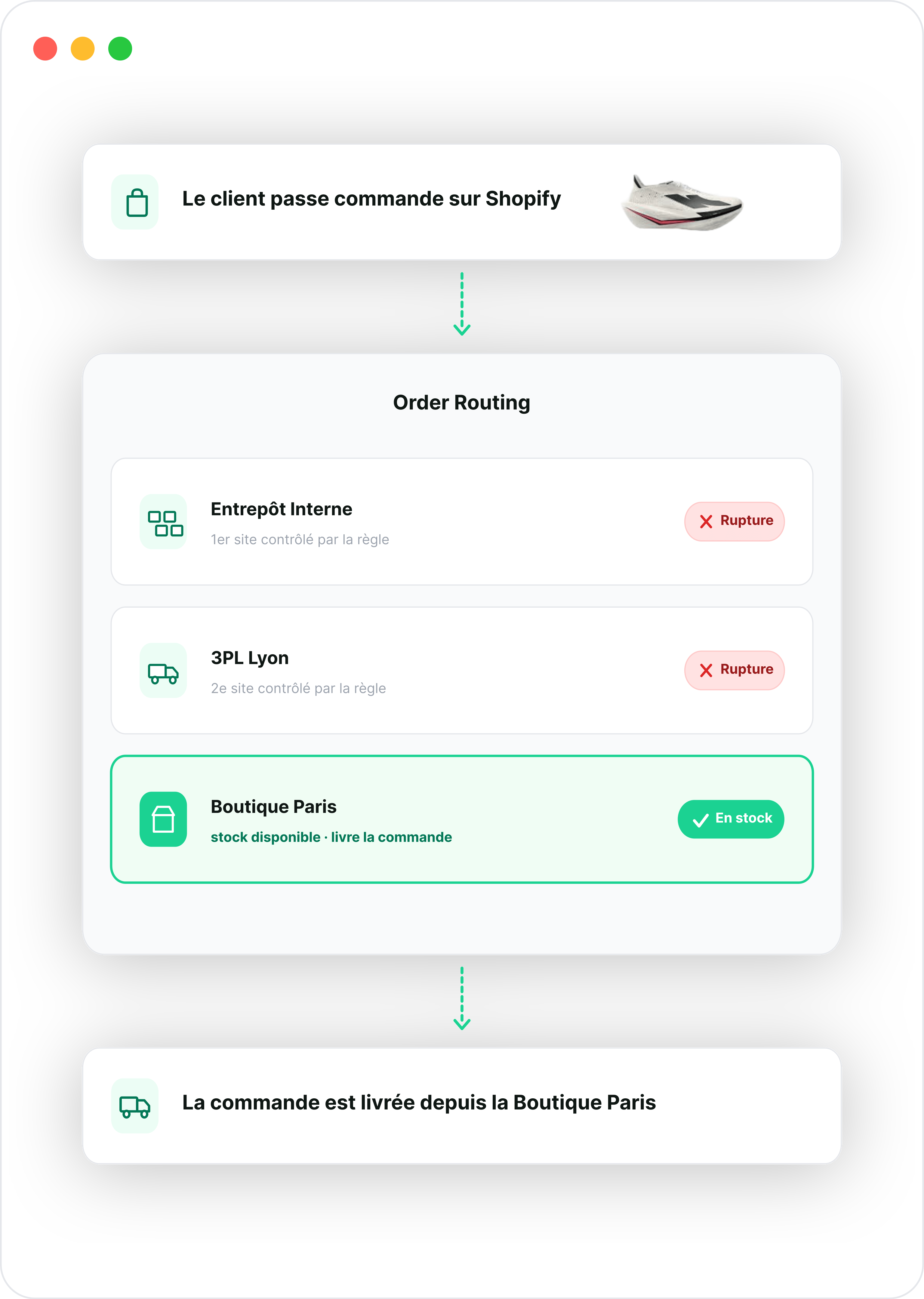
Set your business rules once: which site ships which order, based on available stock, lead times, costs or customer priorities. No-code configurable rules.
Real-time distributed inventory
Unified multi-site view
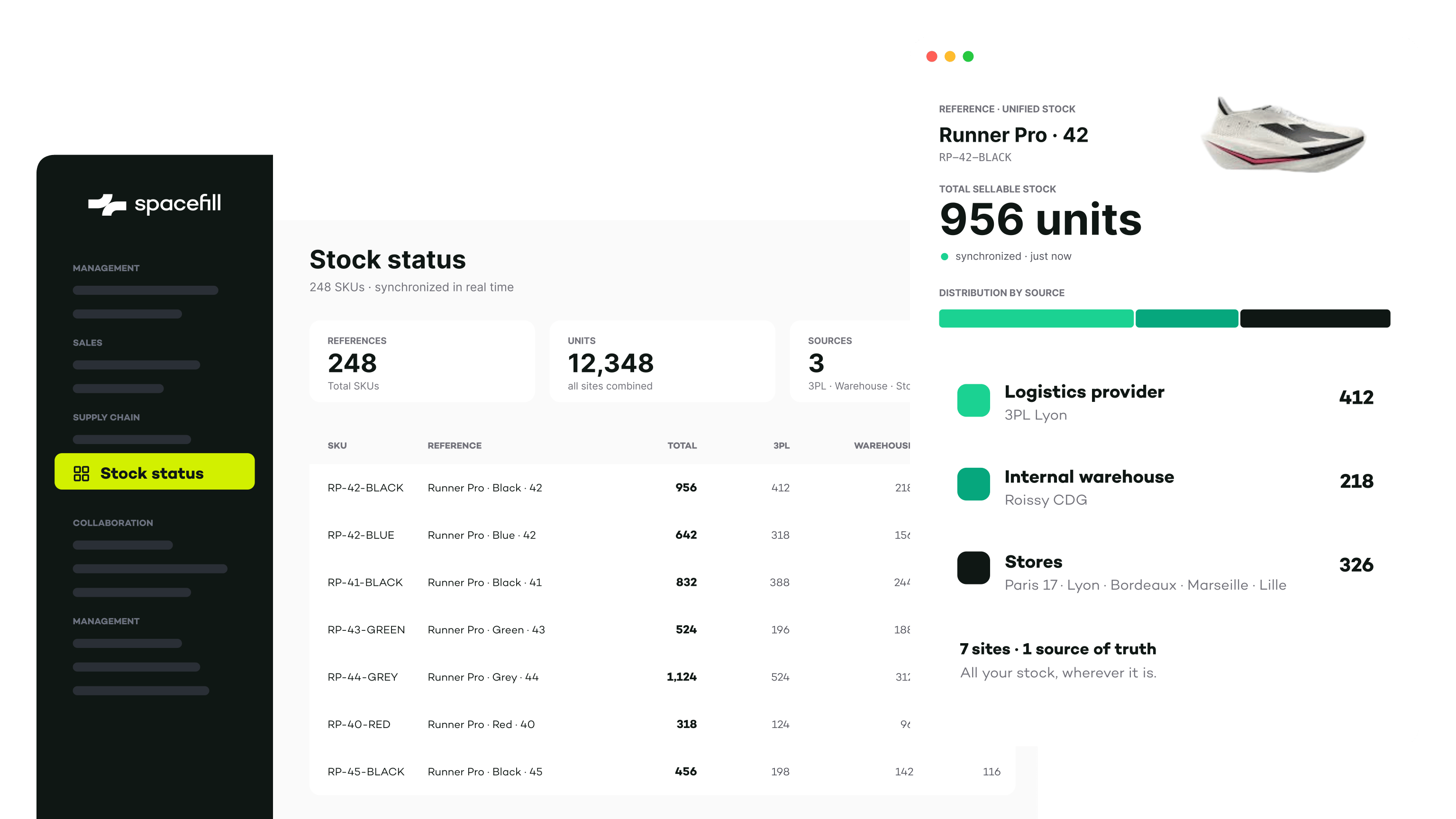
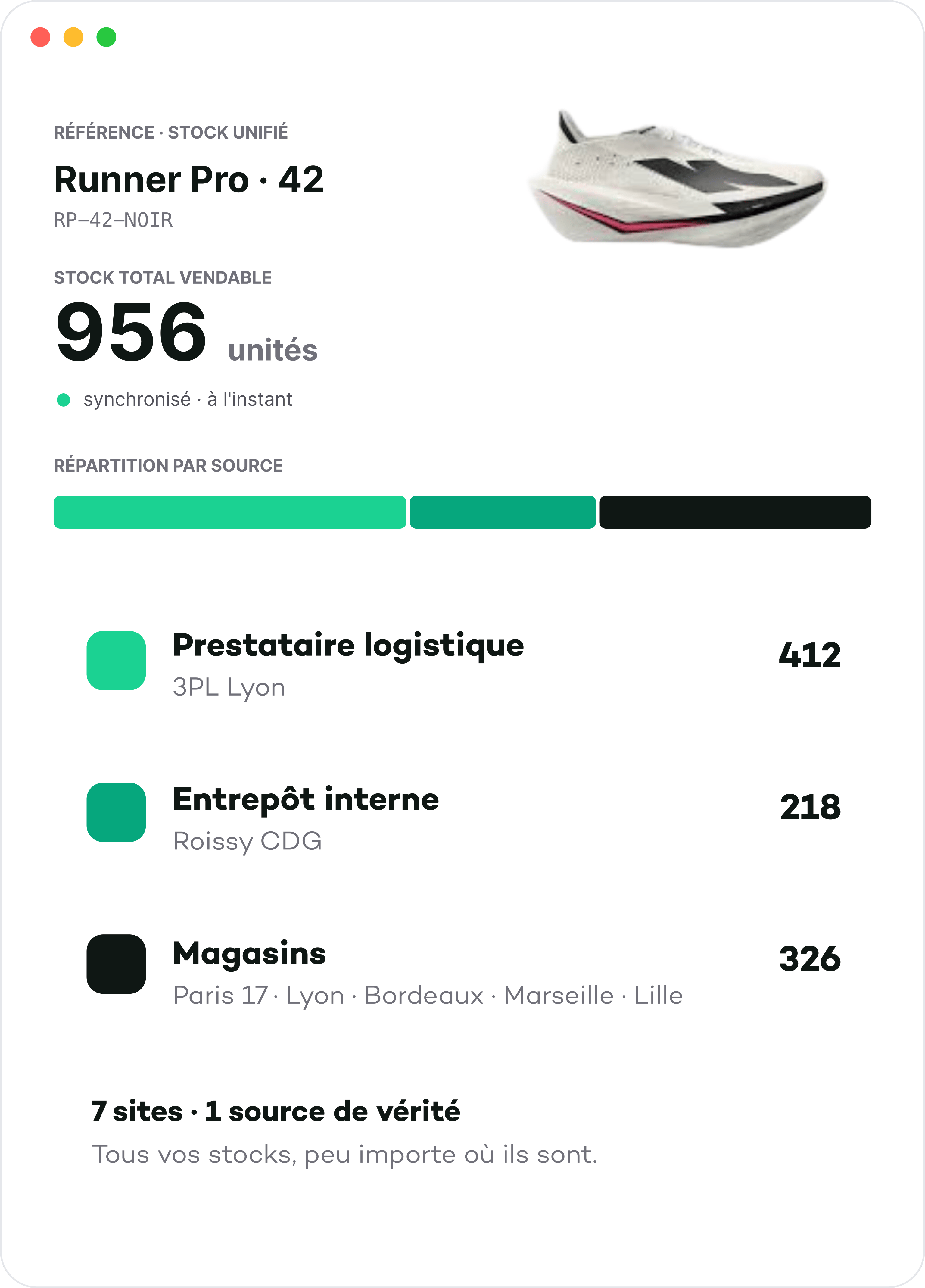
A single view across all your inventory (stores, own warehouses, 3PLs). Real-time sync with WMS systems, automatic reconciliation, per-site threshold alerts.
Dynamic delivery promise
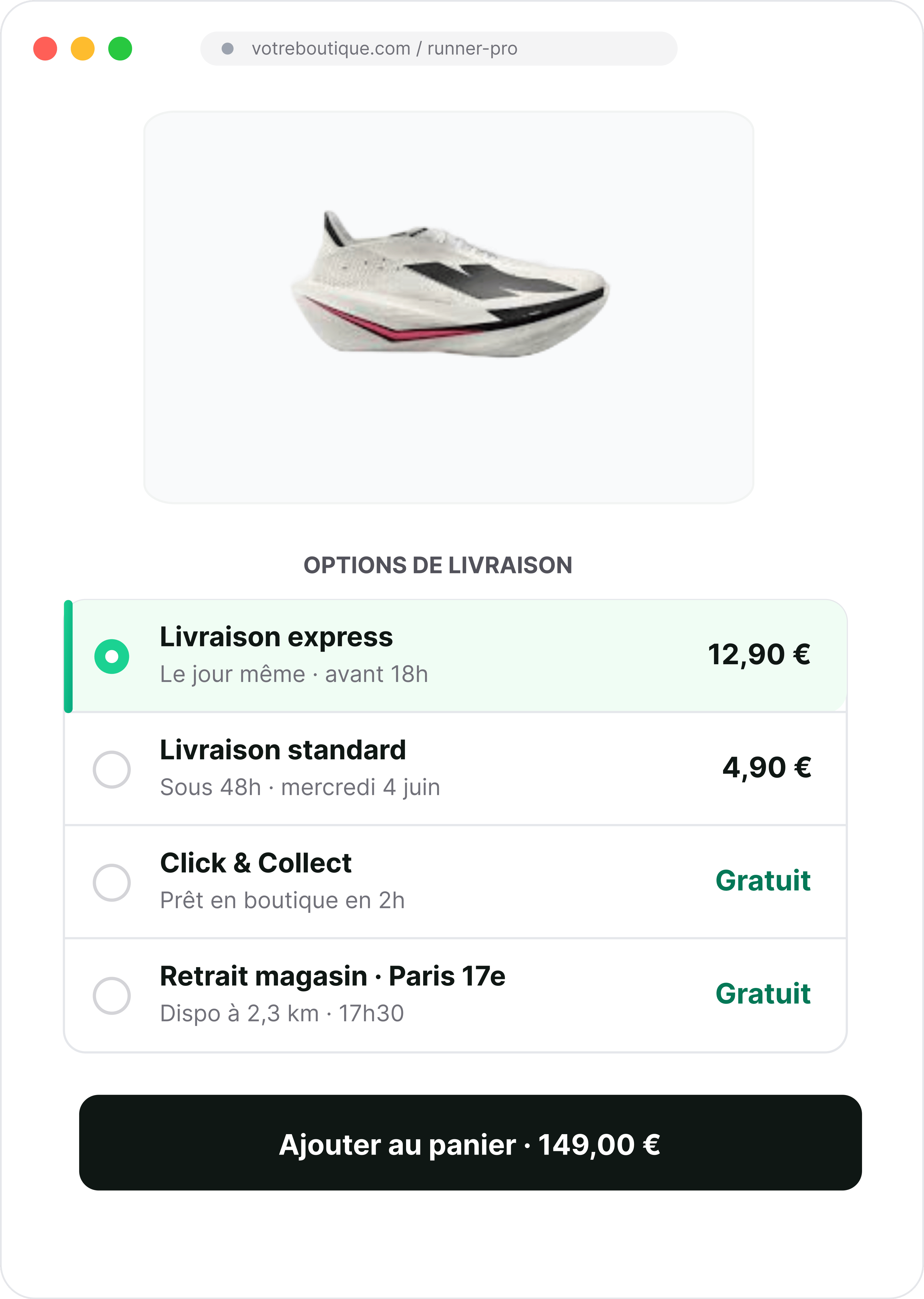
Precise date at checkout
Show a precise delivery date at checkout, calculated in real time from stock, shipping site and carrier lead times. +12% conversion on average.
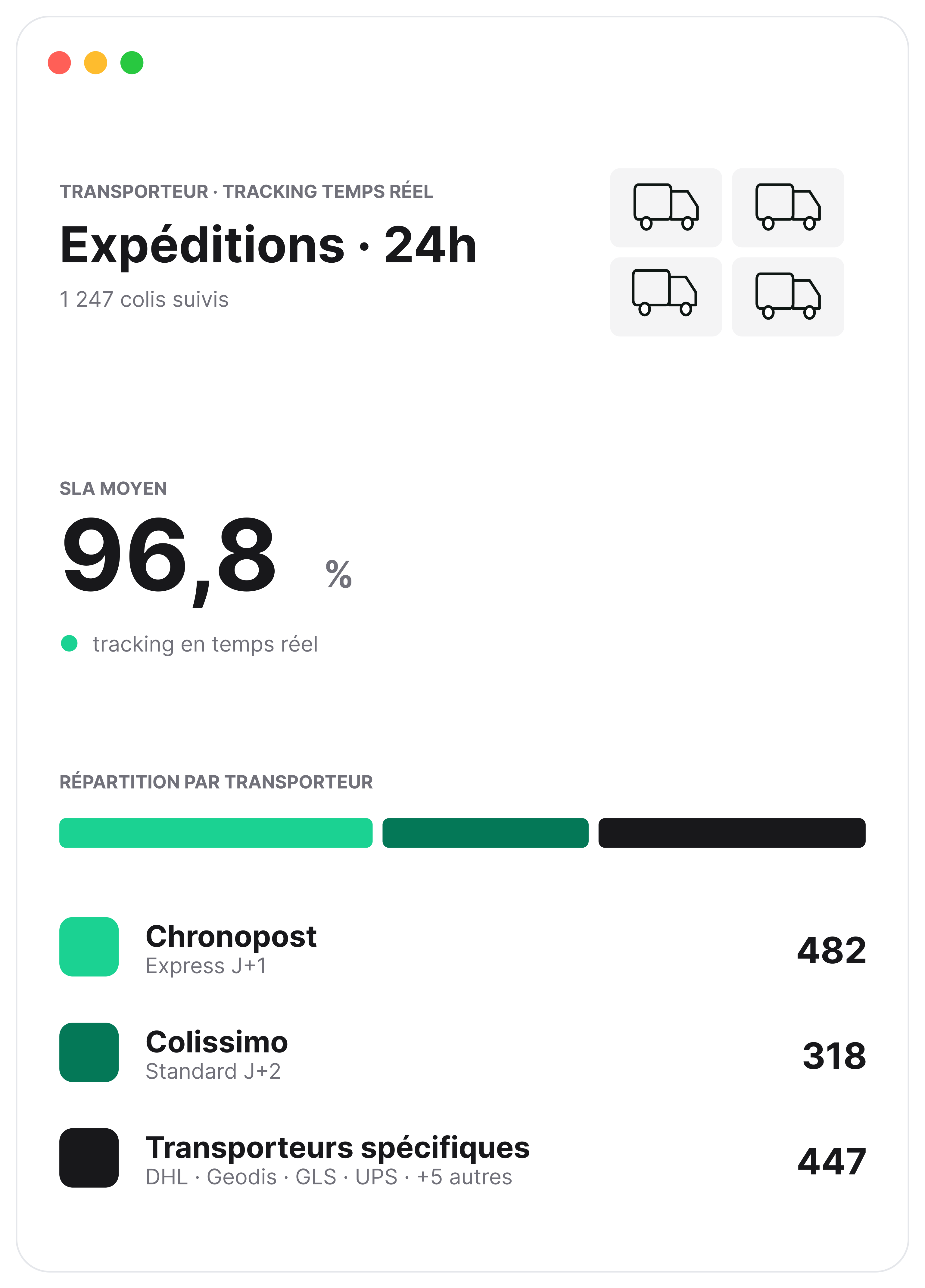
Multi-carrier transport management
Tracking + SLA
Track all your shipments across every carrier. Real-time tracking, transport anomaly detection, carrier SLA measurement from a single interface.
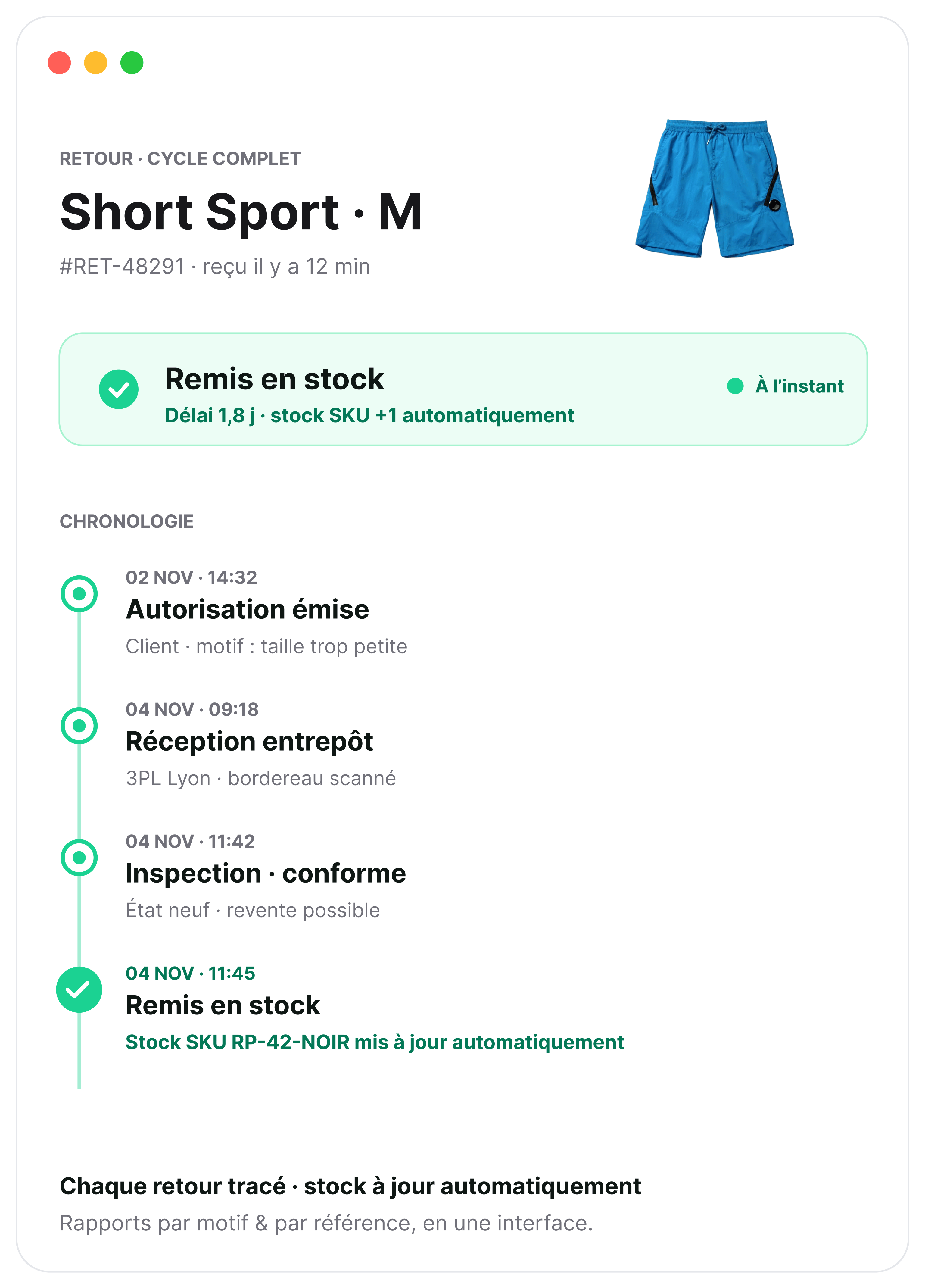
Returns management
Authorization → Restocking
Manage return flows from authorization through to restocking. Every return is traceable, stock updates automatically on receipt. Reports by reason and by SKU.
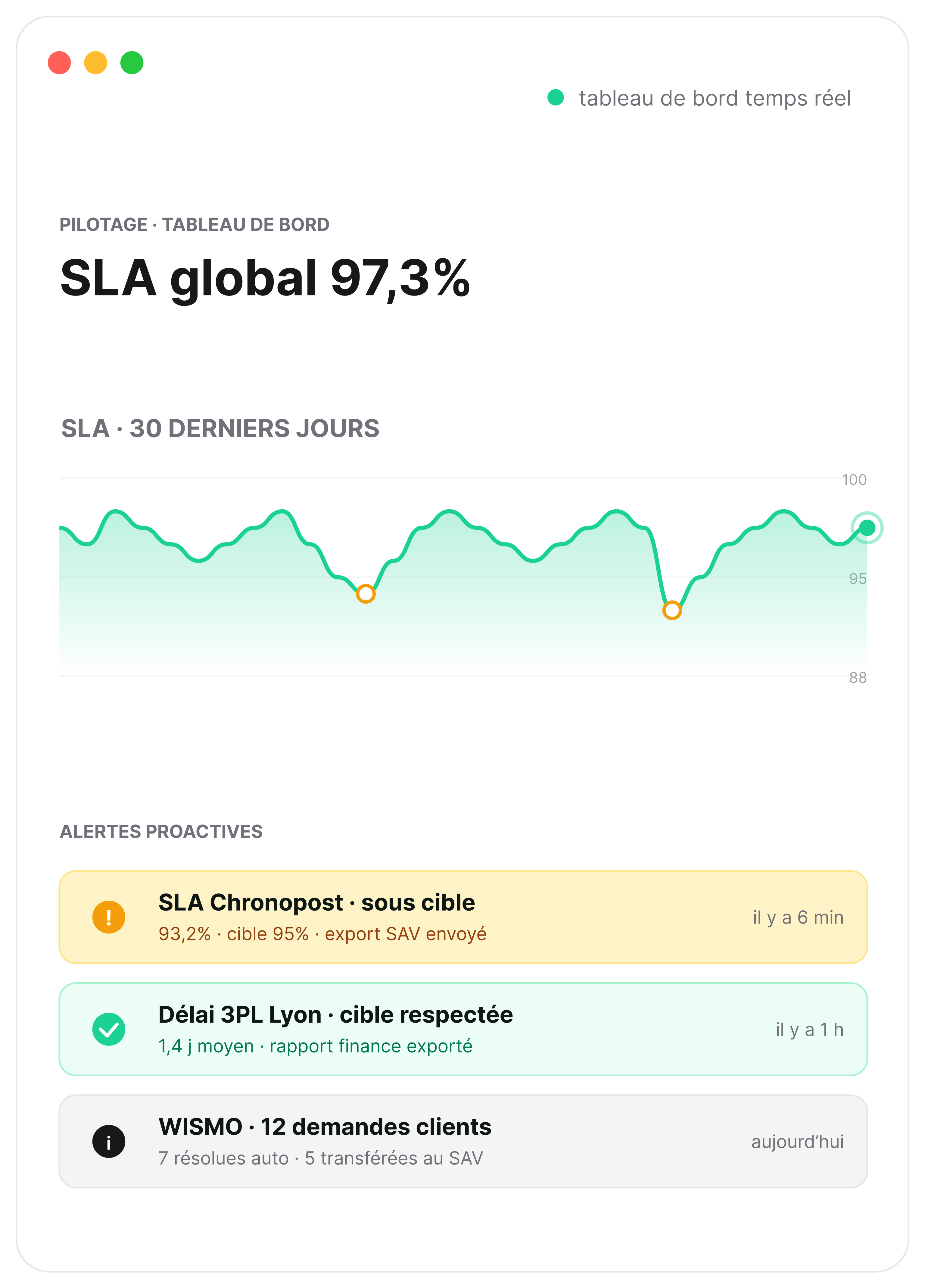
Performance monitoring and reporting
SLAs, lead times, WISMO, alerts, incidents
Track end-to-end performance: SLAs by provider and by carrier, processing times, error rates, WISMO. Real-time dashboards, proactive alerts, exports for support, finance and management.
Multichannel order management
B2C, B2B, marketplace, EDI
Centralize every order (B2C, B2B, marketplace, EDI) in a single repository. Each order is tracked, prioritized and routed according to your rules. Automatic import from ERP, CMS, EDI.
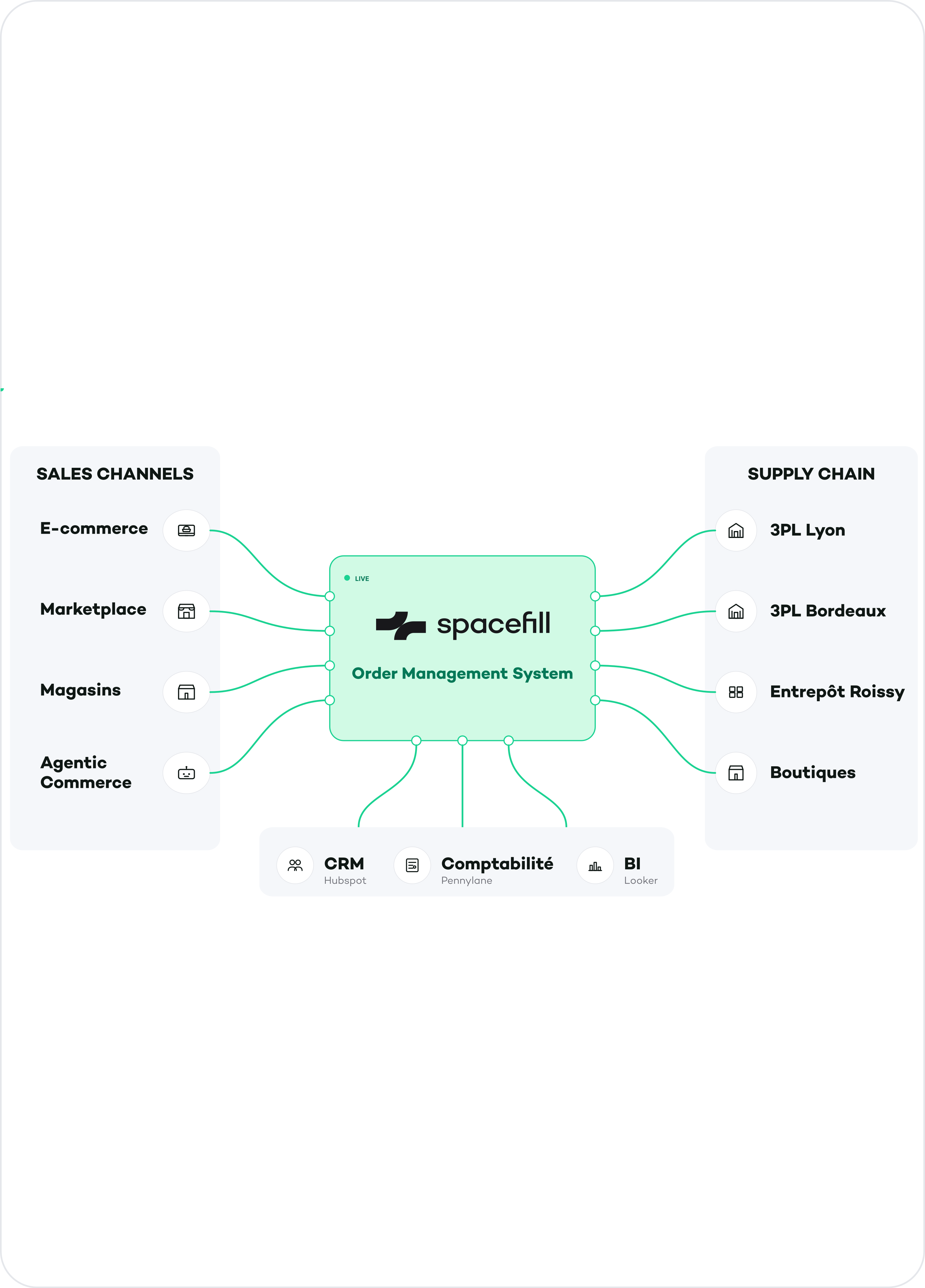
Why Spacefill
An OMS built for companies that operate with or without logistics partners.
Your sales journeys need to be seamless, your supply chains rarely are. We guarantee fluidity and transparency from end to end.
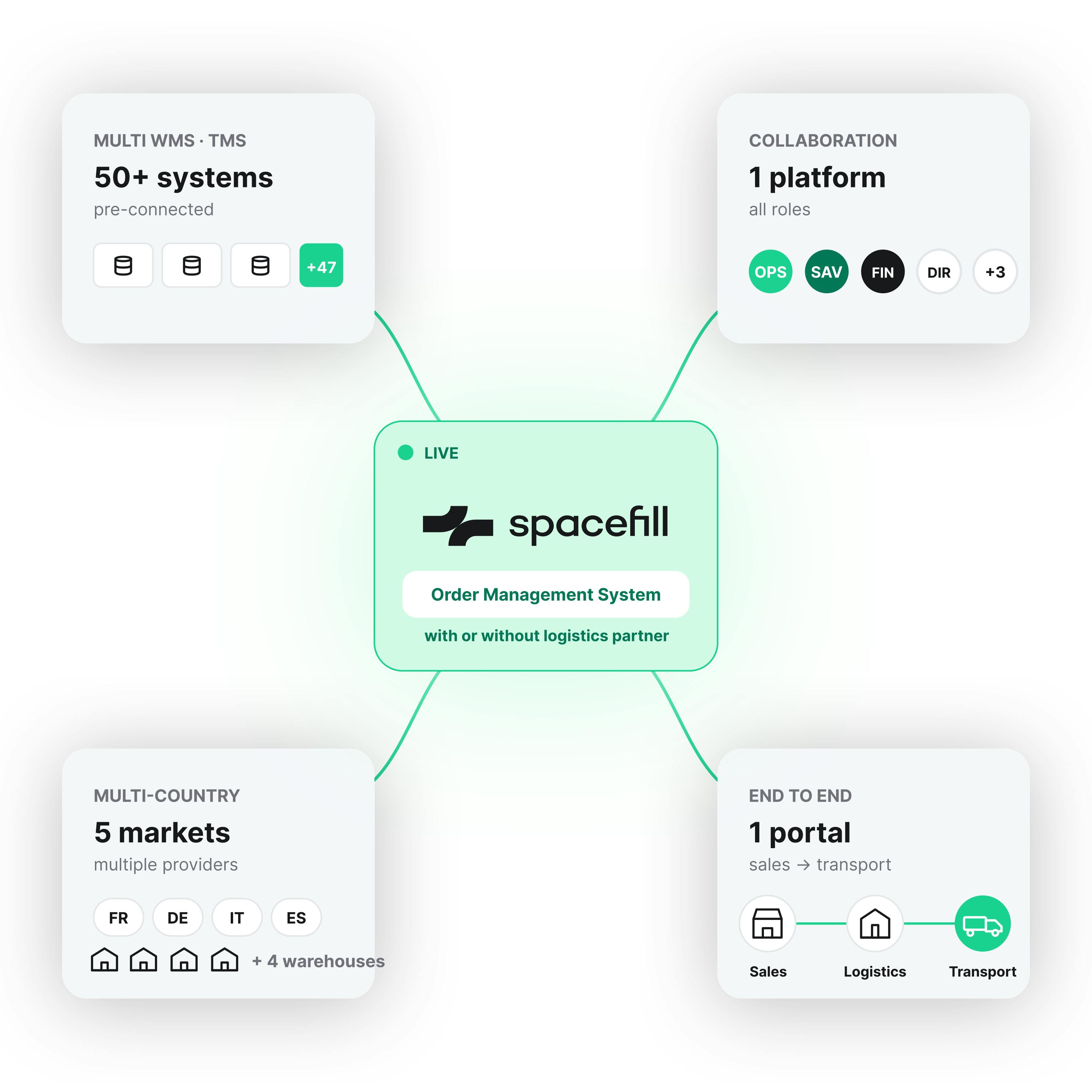
- Multi WMS. Multi TMS.
- Multi-use. Collaborative. Single platform.
- Multi-warehouse. Multi-country.
- Sales. Logistics. Transport.
Before / after
What actually changes
For a brand or distributor running multiple sales channels and multiple storage sites.

Order transmission
CSV export from the ERP, email to the provider, manual entry into the WMS. 3 people, 2 hours, 0 traceability.

Automated transmission
Automatic, whatever the source channel (EDI, Shopify, API, marketplace). The WMS receives the order with no human intervention.
Available stock
Excel file reconciled every morning from multiple exports. Usable at 9am, wrong by 10am.
Real-time stock
Synced in real time from every connected WMS. One single view, reliable, available to all teams at all times.
Late order
The customer calls support, support calls the 3PL, the 3PL calls the carrier. Answer within 48 hours.
Detected before the customer notices
Spacefill flags the anomaly before the customer calls. Support has the full tracking in seconds. WISMO down 75% on average.

Results measured at our customers
-%
01234567890123456789
01234567890123456789
WISMO ("where is my order" calls)
-%
01234567890123456789
01234567890123456789
manual data entry and reconciliation work
-%
01234567890123456789
01234567890123456789
order picking errors
01234567890123456789
01234567890123456789
01234567890123456789
of contractual SLAs measured
01234567890123456789
lower TCO than a traditional OMS
Customer story
From 3 days of reconciliation to zero
Before Spacefill, the supply chain team spent 3 days a month reconciling stock between the ERP and the 4 depot WMS systems. Customer EDI orders were routed manually, with stockouts invisible on the sales side.
- Today, stock is unified in real time.
- EDI orders are routed automatically according to business rules.
- SLAs are measured continuously, by depot and by customer.
- Manual reconciliation is gone.
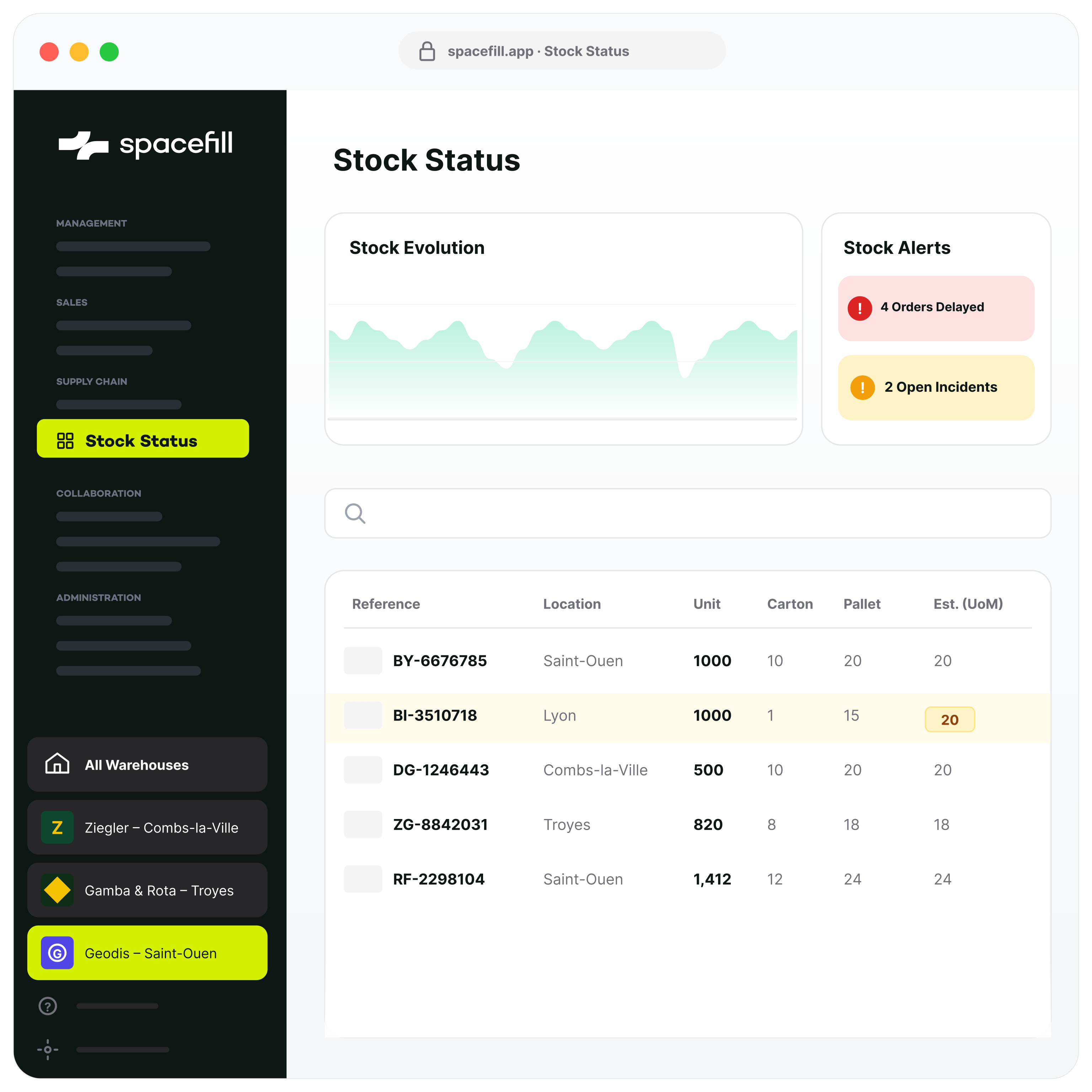

Integrations
Your WMS is probably already in our network
50+ WMS natively connected. Compatible with 100% of WMS on the market via API or EDI. Integration in under 30 days on average.


Deployment
A vendor that does the work with you
Scoping and design
Scoping and design
Mapping your flows, existing systems and business rules. Integration mapping. Phased deployment plan.
Integrations run by Spacefill
Integrations run by Spacefill
Spacefill teams build the connections to your WMS, ERP, CMS, marketplaces and carriers. No external integrator to hire.
UAT, training and go-live
UAT, training and go-live
End-to-end testing, real datasets, training for ops, support and sales teams. Progressive go-live.
Ongoing support and evolution
Ongoing support and evolution
Dedicated Customer Success Manager. Regular product releases. Connectors maintained by Spacefill. You validate, you don't code.
What you want to know before deciding
An OMS is the software layer that orchestrates the entire order lifecycle: capture, stock allocation, routing to the right shipping site, transport management, tracking through to delivery, returns handling. It sits between your sales channels (e-commerce, marketplaces, B2B) and your execution systems (WMS, 3PL, carriers). It keeps the customer promise consistent and the execution reliable.
A WMS runs the physical operations of a warehouse (receiving, storage, picking, shipping). An OMS orchestrates the commercial and logistics layer between channels and WMS systems: it decides which WMS, 3PL or store should handle which order, aggregates stock across multiple WMS, feeds the delivery promise at checkout, and tracks the order end to end. Spacefill OMS connects to your WMS, it doesn't replace them.
From a few weeks to a few months depending on the complexity of your systems. Typical deployments (ERP + 1-2 WMS + Shopify) are live in 6 to 12 weeks. Multi-country, multi-3PL deployments take 4 to 6 months, with a progressive go-live market by market. Integrations are built by Spacefill teams, not left to the customer.
Yes. Spacefill connects to SAP S/4HANA, Sage X3, Oracle, Odoo, Axelor, Divalto and other ERPs through native connectors or API. The OMS doesn't replace your ERP, it plugs into it. The ERP remains the source of truth for financial and commercial data, Spacefill becomes the source of truth for operational logistics data.
Yes. Spacefill handles standard EDI orders (X12, EDIFACT) and the contractual delivery terms specific to B2B: SLAs per customer, delivery time slots, specific delivery notes, custom packaging. B2B and B2C flows coexist on the same platform with separate orchestration rules.
Yes. Spacefill calculates the available delivery date in real time based on stock, shipping site, carrier cut-offs and transit times. That information is exposed to your storefronts (Shopify, PrestaShop, WooCommerce, Magento, marketplaces) via API. Brands using it measure an average +12% checkout conversion thanks to the accuracy of the promise.
No, not for standard cases. WMS, ERP, CMS and marketplace integrations are built by Spacefill teams. The customer validates the business rules, runs acceptance testing on the flows and trains their teams. For custom cases (proprietary internal tools, highly specific EDI flows), an IT team on the customer side is useful but not required, thanks to the documented Open API.
OneStock and KBRW are OMSs built for omnichannel retail: stores, ship-from-store, very large accounts. Spacefill enables companies with a complex or outsourced supply chain to orchestrate their entire logistics network: multiple warehouses, multiple 3PLs, multiple WMSs. Spacefill goes live in a few weeks and replaces neither the ERP, the WMS nor the TMS.
Ready to digitize your supply chain end to end?