

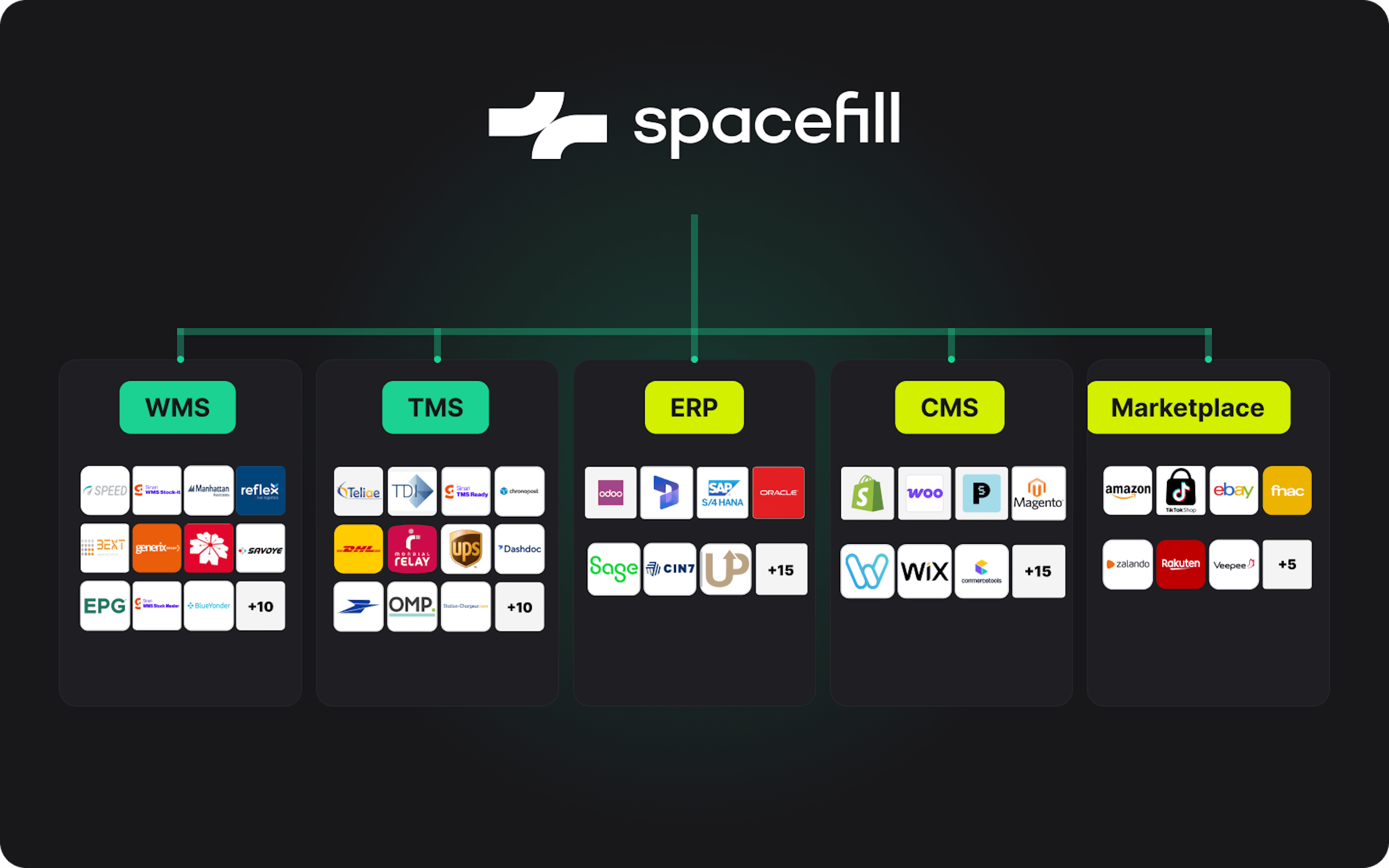
50+ WMS natively connected. Compatible with 100% of WMS on the market via API or EDI. Integration in under 30 days on average.

Discover the OMS
Orchestrate every order from capture to routing, across channels and sites.
Discover the IMS
Unify your inventory (warehouses, stores, transit, suppliers) into one real-time view.

Discover our Shipping Management
Track every parcel from picking to delivery, across all carriers.

3PL Management
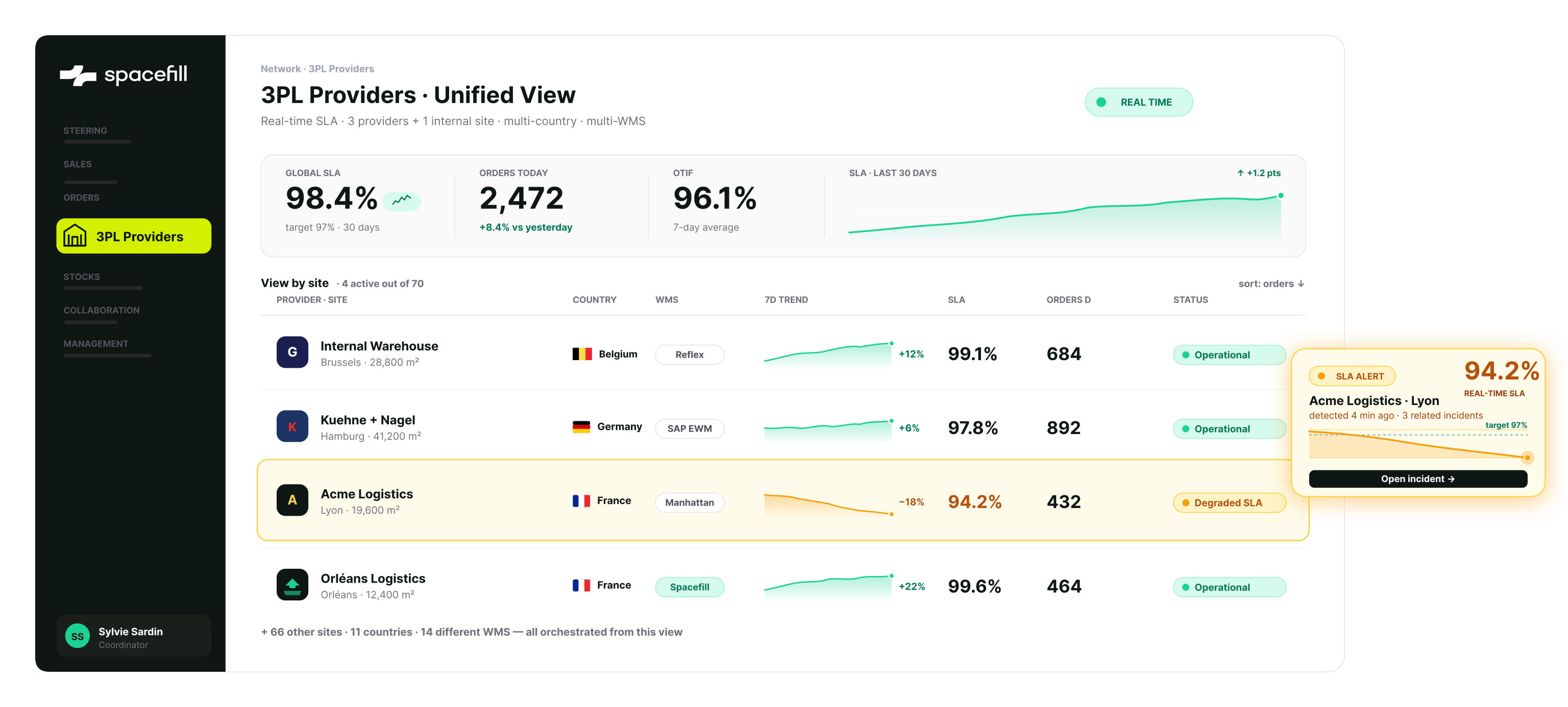
Manage your logistics providers on the same data they see, in real time.

Discover our Workflows & Rules Engine
Automate your business rules with no IT ticket: trigger, condition, action.

Discover our AI agents
Four AI agents connected to your OMS: assistant, detection, data entry, routing.

Discover our Middleware
50+ native connectors and a REST API to plug in your entire ecosystem.
Stand out in RFPs
Walk into 3PL RFPs with a white-label customer portal.
Simpler, more reliable connectivity with my customers
Simpler, more reliable connectivity with my customers and brands.

Give my customers full transparency
Your customers act on orders, incidents and inventory on their own.
Boost productivity on administrative tasks
Double the volume your admin team handles.
Order Management System
The OMS that digitizes your supply chain end to end, from 100K to 10M orders a year.

IMS
Centralize, manage and automate your inventory operations
3PL Control Tower
Outsource logistics without losing control of execution at each 3PL.
WMS Middleware
Connect any WMS and push logistics data out to your entire IT landscape.
Deliver on the customer promise (ATP/ATS)
Show an exact date from the product page, and hold to it.
Manage the supply chain end to end
Aggregate your WMS, TMS, 3PLs and carriers in real time on a single platform.
Orchestrate multi-site flows and inventory
Orchestrate inventory and orders across multiple warehouses and stores.
Manage my logistics providers end to end
A control tower over your 3PLs and carriers, with no IT project.
Manage your 3PLs
on the same data, in real time
SLAs measured automatically, visibility from picking through to final delivery,
one dashboard shared between the brand and its providers.
Multi-country, multi-WMS, multi-TMS. One 3PL or seventy: the same interface.

01234567890123456789
01234567890123456789
01234567890123456789
of contractual SLAs measured automatically, in real time
-%
01234567890123456789
01234567890123456789
WISMO requests, thanks to shared visibility
-%
01234567890123456789
01234567890123456789
logistics-related support tickets
01234567890123456789
01234567890123456789
picking errors eliminated
01234567890123456789
faster than a traditional WMS integration
The problem
Outsourcing logistics is quick. Managing it properly is another story.
Handing execution to one or several 3PLs doesn't remove complexity. It moves it. And without the right tools, brands end up steering their supply chain blind, on partial data that arrives late.

SLAs are measured quarterly, on data nobody can verify
Performance reviews rest on Excel exports supplied by the provider. The numbers get debated, not verified. The result: unproductive meetings with no shared data, and service gaps that persist because both sides analyze them differently, on different figures.

Issues are discovered when the customer calls
A shortage at the provider, a delay in picking, a stuck parcel: none of it surfaces in real time. It arrives 48 to 72 hours later, through the end customer's complaint.
Visibility stops at the warehouse door
The 3PL's WMS reports "shipped". And then? The tracking number is in an email, the carrier is in another system, the delivery date is anyone's guess. Logistics data and transport data don't live in the same tool.

Adding a 3PL is an IT project. Cancelling an order at the provider is an email.
Connecting a new WMS takes months. Changing a delivery address, reassigning an order to another warehouse, cancelling before picking: all of it goes through emails or phone calls. No traceability, no automation.
What changes
Five situations. One tool.
Real cases supply chain leaders and logistics teams recognize instantly.

SLAs disputed at quarter end
SLAs are measured once a quarter, on an Excel file supplied by the 3PL. The numbers get debated, never proven.

SLAs measured continuously
SLAs are measured continuously from real events (pick, pack, ship, delivery). The same data is available to the brand and to the 3PL.
Issue found 48 to 72 hours later
A picking issue is discovered when the customer calls support, 48 to 72 hours after the problem occurred at the provider.
Alert the moment the WMS detects it
An alert fires as soon as the WMS detects the problem. The team can reassign the order or warn the customer before it escalates.
3PL stock in a silo
Stock at the 3PL is a number received by email in the morning. It isn't part of the global view of stock available to sell.
3PL stock integrated in real time
The 3PL's stock is integrated in real time into the unified view. It feeds available-to-sell stock and the routing engine.

How it works
From connecting the 3PL to measuring performance, continuously
Step 1
Connecting to the 3PL's WMS and TMS
Spacefill plugs in through the matching connectors. 50+ pre-integrated WMS/TMS via API, EDI, CSV or FTP. The 3PL changes nothing.

Step 2
Pick orders and order management
Spacefill generates orders to the WMS and translates units. Cancellations, address changes and reassignments are handled from the interface.

Step 3
Continuous logistics and transport tracking
Pick, pack, ship: every event flows back in real time. Multi-carrier tracking built in. Visibility doesn't stop at the door.

Step 4
SLA measurement and redistribution
SLAs calculated automatically by 3PL, by site, by channel. Data pushed to your ERP, Zendesk/Gorgias, Slack/Teams and BI.

What sets us apart
Four capabilities other OMS platforms don't cover

Collaborative issue management
An issue detected at the 3PL is surfaced to the brand in real time. Both parties see the same event, at the same moment, with the same data.

Customizable BI, in real time
Each brand configures its own views: OTD by 3PL, picking lead time, cost per channel, dispute rate by site. Calculated in real time, not reconstructed after the fact.

AI to query your data and automate
Ask questions about your 3PLs in plain language. The AI agent accesses real-time data and answers in seconds.
Middleware: from CMS to the 3PL's WMS
Spacefill bridges sales channels (Shopify, Amazon, Mirakl), ERP, the 3PL's WMS and the carrier's TMS. One platform for the whole chain.
What actually changes
01234567890123456789
01234567890123456789
01234567890123456789
of contractual SLAs measured automatically
-%
01234567890123456789
01234567890123456789
WISMO requests
01234567890123456789
01234567890123456789
picking errors eliminated
-%
01234567890123456789
01234567890123456789
logistics-related support tickets
01234567890123456789
faster to deploy than a traditional WMS integration
Integrations
Your WMS is probably already in our network


Common questions
What we hear before people decide

"My 3PL won't want to change tools or open up its system."
The 3PL changes nothing. Spacefill connects to its existing WMS through the matching connector. The provider keeps working in its own tool. Data flows into Spacefill on the brand side without the 3PL having to modify anything. Spacefill is already connected to 500+ provider warehouses across Europe: in most cases, the connector already exists.
→ 500+ 3PL warehouses on the Spacefill network
"I only have one 3PL. Is it worth it?"
Yes. The value starts with the first provider: real-time visibility on orders, SLAs measured automatically, proactive alerts, returns handled, data redistributed to support and your ERP. The day a second 3PL is needed, the infrastructure is already in place: connection in days, not months.
→ E-commerce use case: 35% fewer support tickets with a single 3PL
"We already have an ERP and a WMS portal to track orders."
An ERP handles orders well when all execution is internal. The WMS portal gives you the provider's view, not the brand's consolidated view. Spacefill sits on top of both: it unifies stock across 3PLs, brings in transport data, measures contractual SLAs and redistributes information to support, Slack and finance.
→ Native connectors for SAP, Sage, Oracle, Odoo
Every provider managed, every order tracked
3PL management questions
3PL management is an OMS's ability to steer logistics execution outsourced to external providers (3PLs) from a single interface. Spacefill connects your 3PLs' WMS, aggregates logistics and transport data in real time, measures contractual SLAs and shares a common dashboard between the brand and its providers.
Spacefill has pre-built connectors for 50+ WMS on the market (Reflex, Infolog, Effitrace, Speed, ODATIO, StockIt, Mecalux, EPG, and more) and TMS platforms (GedMouv, Akanea, Sendcloud, ITinsell, Teliae, TDI). The connection runs over API, EDI, CSV or FTP depending on what the provider's systems support. If the 3PLs in a network use different WMS and TMS, Spacefill adapts to each one. The 3PL changes nothing about its tools or its processes.
Spacefill measures contractual SLAs in real time from the logistics events reported by the 3PL's WMS (pick, pack, ship) and from transport data (collection, delivery). The data is indisputable because it's shared between the brand and the provider. Gaps trigger configurable alerts. Performance reviews rest on facts, not exports.
No. The 3PL keeps working in its usual WMS. Spacefill plugs into it through the matching connector. Nothing changes for the provider. Spacefill is already connected to 500+ 3PL warehouses across Europe: in most cases the connector exists and the provider already knows the platform.
Yes. Spacefill brings transport data (tracking numbers, collection and delivery statuses, multi-parcel, multi-carrier) into the same view as your logistics data. Visibility doesn't stop at the warehouse door: it covers the full cycle from picking to final delivery.
Yes. Spacefill lets you cancel an order, change the delivery address or reassign an order to another warehouse, as long as the 3PL hasn't started picking. These actions are triggered from the Spacefill interface and propagated automatically to the provider's WMS. Every change is traced.
Spacefill publishes logistics events to your connected tools: ERP (SAP, Sage, Odoo), customer service CRM (Zendesk, Gorgias), communication tools (Slack, Teams), accounting (Pennylane, Xero, Sellsy) and BI. It works both ways: data from your ERP or accounting system can feed back into Spacefill. Support, finance and management teams get logistics data without calling the warehouse.
Yes. Spacefill creates return orders from the original order, generates return labels through integrated carriers (Teliae, Sendcloud, ITinsell), sends the expected receipt to the 3PL's WMS and handles gaps between declared and received. Undeclared returns and returns with no expected receipt are covered too.
There's no technical limit. Spacefill was designed for setups ranging from a single 3PL up to 70+ providers across several countries, each with its own WMS and its own TMS. The multi-3PL, multi-country, multi-WMS architecture is native, not bolted on: it's the foundation of the platform.